
TPU Film Customization for Laminated Glass: OEM/ODM Capabilities, Quality Control, and a Proven Defense Application
TPU Film Customization for Laminated Glass: OEM/ODM Capabilities, Quality Control, and a Proven Defense Application
When laminated glass projects move beyond standard specifications—such as custom widths for bulletproof glass, a specific interlayer thickness for armored vehicles, or a specialized roll length for high-rise glazing—buyers need more than a catalogue-grade TPU film. They need a thermoplastic polyurethane (TPU) film manufacturer that can support OEM length and width customization, ODM design and production, 100% testing, and after-sales technical support. This article explains how to evaluate a TPU film supplier for customized laminated glass interlayers, with a focus on capability verification, decision criteria, and a proof case from Pakistan.
What Does Custom TPU Film Mean for Laminated Glass?
Custom TPU film for laminated glass means the interlayer film is produced according to a buyer’s specific dimensional, performance, or design requirements rather than only supplied from a standard product range. The most common customization is dimensional: film length and film width. In practical terms, a manufacturer offering OEM services with length and width customization can cut or produce TPU film rolls that match the exact width of a glass lamination line, reducing per-roll waste and improving process efficiency.
For a laminated glass producer, the practical value of dimension customization is straightforward. Standard TPU film widths may not match the glass sizes used in a specific project, such as 2.2-meter-wide architectural panels or 1.8-meter armored glass. If a supplier can customize width and length, the buyer avoids the cost, waste, and handling issues caused by trimming wider rolls or splicing narrower ones.
Customization is not limited to physical dimensions when a manufacturer also provides ODM design and production services. In an ODM model, the supplier designs or adapts the product formulation, construction, or processing approach for the customer’s intended use, then produces it under the customer’s brand or project specification. For TPU laminated glass, the design work may include selecting the appropriate TPU hardness range, optimizing transparency and haze targets, or adjusting mechanical performance to match a ballistic or safety-glazing standard.
Why TPU Film Is Used in Laminated Glass
TPU (thermoplastic polyurethane) film is used as an interlayer in laminated glass for applications that require high transparency, strong adhesion, and resistance to impact, temperature extremes, and environmental stress. It should not be confused with EVA film, which is commonly used for architectural or decorative glass and is typically more economical. TPU is chosen when the project demands higher mechanical performance and reliability, such as in bulletproof glass, shatter-resistant glass, and armored glass.
TPU interlayer film maintains operational performance across a wide temperature range—approximately -70°C to +80°C, based on industry comparisons—making it more suitable than EVA for extreme environments. High-performance TPU films for bulletproof glass typically exhibit tensile strength exceeding 40 MPa and elongation at break above 500%, according to 2026 market data. These characteristics are the material-level reasons why TPU film, rather than standard EVA or ordinary PVB sheets, is specified for safety and ballistic glazing.
One widely recognized global benchmark is the EN 12600 standard, which classifies impact resistance for safety glass. TPU-film-based laminates commonly achieve Class 1B1 or 2B2 performance, meaning the glass retains integrity and resists break-through under pendulum impact testing. For architectural buyers, ASTM C1172-19 also defines quality requirements for laminated architectural flat glass, including glass bonded with TPU interlayers.
OEM and ODM Service Models: What a Capable TPU Film Supplier Should Offer
In the TPU interlayer market, OEM refers to producing film that meets the customer’s specified dimensions, tolerances, and packaging requirements, while ODM refers to a deeper level of involvement where the supplier handles the design or adaptation of the product for a specific application. Many buyers use these terms interchangeably, but they imply different levels of responsibility and should be written clearly into the procurement agreement.
A capable TPU film manufacturer should be able to confirm, in writing, that it can produce customized length and width, support ODM design work, test 100% of its output, and provide technical after-sales support. These four capabilities form a practical checklist for evaluation.
1. OEM Length and Width Customization
Customization of length and width is the most common requirement for laminated glass projects. Glass panels are produced in fixed dimensions, and the interlayer should preferably match the glass format to reduce trim loss and avoid weak seams from multiple pieces. A supplier that can customize roll width and length simplifies the lamination line setup, lowers waste rates, and shortens downstream processing time.
Buyers should verify the supplier’s maximum width capability, width tolerance, roll length control, and whether the same customization can be maintained across repeat orders. If a manufacturer can produce wide-width TPU intermediate film consistently, it is a sign of mature extrusion technology and process control.
2. ODM Design and Production
ODM services matter when a buyer has project-specific performance requirements but does not have a finished TPU formulation. For example, a manufacturer of bulletproof vehicle glass may need a TPU interlayer that retains high light transmittance, withstands autoclave lamination, and provides strong adhesion to both glass and polycarbonate layers. An ODM-capable supplier can design or adapt the film product accordingly, produce samples, validate the product, and then scale up production.
For procurement teams, this means asking not only “what is your standard film model?” but also “can you adapt the product to meet our specific lamination process and performance target?” The supplier’s answer should include their technical resources, R&D personnel, and project history.
3. 100% Testing as a Quality-Control Standard
Full testing—often expressed as “100% testing standards”—means every film roll is inspected against defined parameters rather than only a sample batch being checked. In safety and ballistic glazing applications, interlayer defects can compromise the entire laminated glass panel, so sampling is often insufficient.
Buyers should ask for details on what is tested: thickness uniformity, visual defects, contamination, tensile strength, elongation, haze, light transmittance, and adhesion performance. A supplier that applies 100% testing at production stage is better positioned to deliver consistent interlayers for certification-dependent projects.
4. Technical After-Sales Support
After-sales technical support can include guidance on storage, handling, lamination parameters, autoclave cycles, troubleshooting adhesion failures, and joint sample evaluation. Since TPU interlayers behave differently from EVA or PVB under lamination, buyers often need process support during the first production batches. Technical after-sales support helps reduce line downtime and quality rejects during the ramp-up phase.
How to Evaluate whether a Supplier Can Meet Project-Specific Requirements
Once a supplier has confirmed that it offers OEM/ODM services, quality control, and technical support, the buyer still needs to verify that these statements are real and sustainable. Here are five practical evaluation steps.
Step 1: Map the Laminated Glass Project Requirement to TPU Film Parameters
Start by writing down the glass construction, the lamination method, and the target performance. If the project is bulletproof or blast-resistant glass, the film needs high tensile strength, elongation, and adhesion. If the project is architectural safety glass, impact-classification standards and optical quality may be the priority. The film parameters—thickness, width, roll length, and performance ranges—should be listed as formal technical requirements before contacting suppliers.
Step 2: Ask for the Supplier’s Real Production Capabilities
Request the following information in the initial inquiry:
- Whether OEM length and width customization is available, and what the tolerance range is.
- Whether ODM design and production services are available, and what technical information is needed to start.
- The monthly production capacity for TPU film.
- The lead time for customized products.
- The minimum order quantity for first orders and repeat orders.
- The quality-control procedure, including whether 100% testing applies.
- Available after-sales technical support and how it is delivered.
These questions should be answered in writing. Responses based on vague marketing language should be probed further.
Step 3: Request Samples before Ramping Up to Volume Production
For custom TPU film, sample evaluation is an essential step. A supplier operating under a 100% testing standard should be able to provide samples that represent standard production quality, not laboratory-only quality. Evaluate the samples under the same lamination conditions you would use in production, including the autoclave cycle or hot-melt process, and measure the resulting glass clarity, adhesion, and impact performance before placing volume orders.
MOQ flexibility is important at this stage. For example, a supplier that accepts a small MOQ of 50 kg or one roll can support project-based procurement and allow the buyer to test the product without committing to a full container load. The buyer can then scale up after validation. This approach is especially useful for custom or ODM-oriented TPU film purchases.
Step 4: Verify Production Capacity and Lead Time
Customized production is only useful if it arrives on schedule. A TPU film supplier’s monthly capacity and lead time directly affect project planning. If a supplier has a monthly capacity of 100 tons and can deliver in about 10 days for standard customized items, that is a useful baseline, but the buyer should confirm lead time for their specific width and product design, because custom ODM work may require more time for development and testing.
Capacity is also relevant for long-term relationships. A manufacturer with multiple production lines and a 50,000 m² facility may be more resilient to demand fluctuations than a smaller converter.
Step 5: Confirm Pre-Shipment Acceptance and Documentation
For customized film, acceptance procedures protect both buyer and supplier. Pre-shipment testing—such as checking the final rolls against agreed width, thickness, and appearance criteria—helps avoid costly rejections after export. Buyers should also agree on the documents that will be provided with the shipment, including test certificates, batch numbers, and material declarations.
In practice, a supplier offering pre-shipment testing and clear acceptance procedures reduces risk for importers who cannot physically inspect the goods before shipment.
Use Cases for Custom TPU Laminated Glass Film
The most common use cases for custom TPU film are those where a standard EVA interlayer is insufficient and a performance-grade material is needed in a non-standard size or design.
Bulletproof and Armored Glass
Bullet-resistant and blast-resistant glass typically uses a multi-layer structure in which TPU film bonds glass-to-glass, glass-to-polycarbonate, or both. Because ballistic panels are rarely produced in standard dimensions, OEM width customization is often required for vehicle glazing, building security panels, and special defense components. TPU’s combination of high tensile strength, elasticity, and low-temperature performance makes it suited for this role.
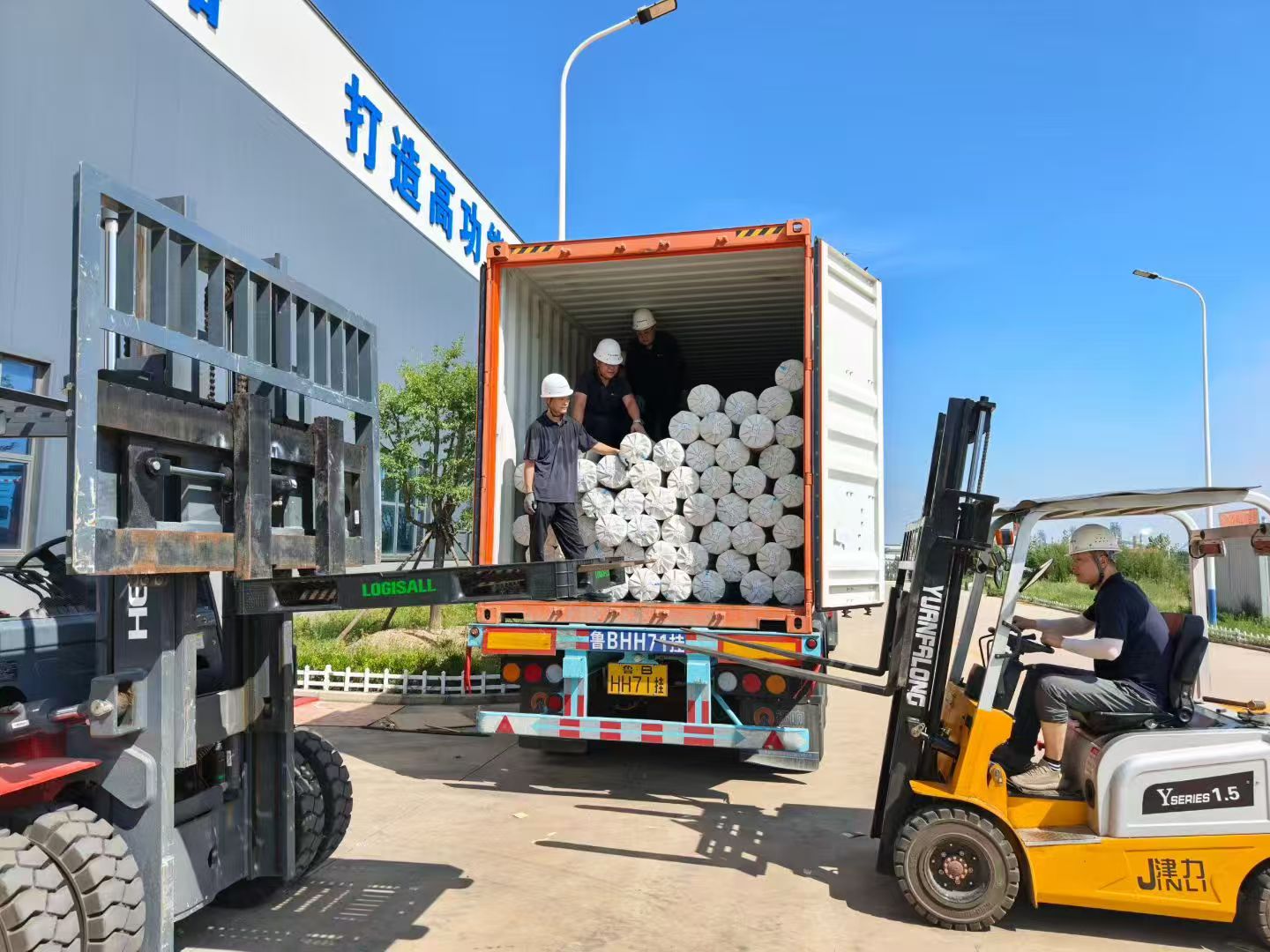
In one documented case, a project in Pakistan used 100 rolls of TPU film for bulletproof glass applications, serving defense-industry customers. The installation achieved stable operation over 2 years and has been described as the only application of its kind in the country.
Safety Glass for Extreme Environments
TPU interlayer film maintains performance across a wide temperature range from -70°C to +80°C, which is why it is specified for glass used in cold-chain facilities, high-speed trains, marine glazing, and other environments with large temperature swings. Customized lengths and widths help manufacturers of these specialized panels reduce splicing and improve the visual quality of the finished glass.
High-Performance Architectural Glass
Architectural safety glass requiring higher impact resistance may also be specified with TPU interlayers. EN 12600 Class 1B1 or 2B2 performance is a common benchmark for such glass. For a curtain wall or skylight project, the TPU interlayer must match precise panel dimensions; hence the need for width and length customization.
TPU Film vs EVA Film for Laminated Glass
TPU film and EVA film are both used as interlayers in laminated glass, but they serve different project priorities. EVA is a lower-cost solution that is commonly used for architectural glass, decorative glass, and solar panels, with acceptable transparency and adhesion for many standard conditions. TPU is selected when the project requires higher mechanical strength, a wide service temperature range, and better resistance to impact and environmental stress.
The following table summarizes the practical comparison for procurement planning.
| Comparison Dimension | TPU Film | EVA Film |
|---|---|---|
| Typical material properties | High tensile strength, high elongation at break, low-temperature flexibility | Good transparency, good adhesion for standard glass |
| Common applications | Bulletproof glass, ballistic laminated glass, armored glass, aviation and marine glazing, high-performance safety glass | Architectural glass, decorative glass, general interior design |
| Temperature performance | Wide operating range, approximately -70°C to +80°C | Suitable for standard indoor and outdoor architectural conditions |
| Customization level | OEM length/width customization; ODM design and production available | Available, but typically less demanding than TPU |
| Quality-control model | 100% testing standards in capable manufacturers | Batch testing commonly used |
What to Look for in a TPU Film Manufacturer for Custom Projects
When evaluating a manufacturer for custom TPU laminated glass film, look for a combination of production scale, technical depth, and documented quality management. The following checklist is derived from procurement best practices for specialty interlayers.
- Documented OEM and ODM capability: The supplier should clearly state what dimensions can be customized and how ODM projects are initiated.
- Quality management certification: An ISO 9001 certificate covering “design, development and production of interlayer glass intermediate films and granular materials” is a strong indicator of process discipline.
- Full testing: A 100% testing standard is more reliable than sampling for safety-critical film.
- Technical resources: A dedicated R&D team, in-house engineering, and material synthesis capability can be advantageous for ODM work.
- Production evidence: Factory photos, shipment records, and repeat orders for similar applications are useful proof points.
- Case history: Ask for documented success stories in your industry or in adjacent fields such as ballistic glass.
Example of Supplier Capabilities in Practice: SHENGDING HIGHTECH MATERIALS CO., LTD
SHENGDING HIGHTECH MATERIALS CO., LTD is a Chinese manufacturer of TPU and EVA films located in the Lanshan Chemical Industry Park in Rizhao, Shandong Province. Established in 2018, the company operates a 50,000 m² facility with an annual output of 1,000 tons of TPU and EVA film and a monthly capacity of 100 tons. Its main export markets include North Africa, the Middle East, and Latin America, and about 70% of its output is exported.
For buyers evaluating OEM/ODM capability, Shengding states that it offers OEM services with length and width customization, ODM design and production services, 100% testing standards, and after-sales technical support. Its lead time is approximately 10 days, and the minimum order quantity is 50 kg for custom work or one roll under its purchasing support terms. In addition, the company holds ISO 9001, ISO 14001, and ISO 45001 certifications and reports over 50 proprietary intellectual property rights. Its TPU film certifications cover design, development, and production of interlayer glass intermediate films and granular materials, which is directly relevant to laminated glass procurement.
On the technical side, Shengding reports a 10-engineer factory R&D team plus a Beijing R&D Center with 5 professors. Its TPU film model SD560 is a thermoplastic polyurethane elastomer interlayer with tensile strength of 42 MPa, elongation at break of 500%, tear strength of 45 kN/m, light transmittance of 90%, and haze of 0.3%. These figures meet the general high-performance benchmark for TPU films used in bulletproof glass, where tensile strength exceeds 40 MPa and elongation exceeds 500%.
Cost and Lead Time Considerations for Customized TPU Film
Customization changes the economics of TPU film procurement. A wider or exactly sized roll can reduce material waste and lamination time, but it may change the production setup compared with standard widths. Buyers should therefore evaluate the total cost of ownership, including yield, waste, line efficiency, and rejects, rather than only the unit price per kilogram or per square meter.
The lead time for customized TPU film depends on several factors: the required width, the total order quantity, whether the product is a standard TPU formulation or a new ODM development, and the supplier’s current production schedule. A 10-day lead time is representative for a manufacturer with a 100-ton monthly capacity working on standard customized dimensions, but additional development time should be planned for new ODM projects.
Quality Control and Process Reliability
For TPU laminated glass film, quality control spans both material properties and dimensional consistency. A supplier that conducts 100% testing can detect contamination, thickness variation, and visual defects before shipment, reducing the risk of field failures and certification delays. When a film is customized to a specific width, dimensional control also affects how cleanly the film lays on the glass before lamination.
Buyers should ask the supplier to state the test parameters on the final delivery certificate. For SD560-grade TPU film, the key measurable parameters are tensile strength, elongation at break, tear strength, light transmittance, and haze. If a supplier can provide batch-specific test data for these parameters, the buyer can trace each roll’s conformity.
Program Procurement: How to Handle Defense and Security Projects
Projects involving armored glass, bulletproof glass, or defense-related glazing often require additional confidentiality, documentation, and long-term stability. A documented case history is valuable because it shows the supplier can execute under the demands of defense-industry buyers.
In the Pakistan case referenced above, the TPU film application for bulletproof glass involved 100 rolls and served defense-industry customers. The project was completed within 2 years and achieved stable operation over 2 years. It is reported as the only application of its kind in the country. For a procurement team, this level of specificity—quantity, duration, and stable operation—is more useful than a generic claim of experience.
FAQ
What certifications should a TPU film supplier have for customized laminated glass interlayers?
At minimum, a supplier should have ISO 9001 certification for quality management. For TPU film used in laminated glass, the certification scope ideally covers design, development, and production of interlayer glass intermediate films and granular materials. Depending on the destination market, buyers may also require REACH and RoHS compliance for Europe or FDA-related requirements for the United States. Always verify the certificate number, issuing body, and validity dates before placing an order.
How much TPU film can a manufacturer make per month and how long does a custom order take?
Production capacity and lead time vary by supplier. One example is SHENGDING HIGHTECH MATERIALS CO., LTD, which reports a monthly capacity of 100 tons and a typical lead time of 10 days for its production model. For new ODM designs or unusual dimensions, additional development time may be required. Buyers should ask for the supplier’s current capacity and a production schedule before confirming the order.
Can TPU film be made to specific length and width for laminated glass projects?
Yes. OEM services commonly include length and width customization. A supplier that offers this capability can produce TPU film rolls to match the glass dimensions used in a specific laminated glass line, reducing waste and simplifying lamination. Confirm the maximum width, tolerance, and whether the customization can be reliably repeated on future orders.
What quality-control methods are used for custom TPU film?
For safety-critical applications, look for a manufacturer that applies 100% testing standards, meaning every roll is tested rather than only samples. Test parameters typically include tensile strength, elongation at break, tear strength, light transmittance, haze, thickness, and visual inspection. The buyer should agree on acceptance criteria and request pre-shipment test results.
What is the minimum order for customized TPU film?
Minimum order quantities vary. Some suppliers support a low MOQ of 50 kg or one roll, which is practical for project-based procurement and initial sample validation. After the buyer validates the film, the supplier can scale up to full-volume production with the same customization.
Conclusion: Custom TPU Film Is a Capability Decision, Not Just a Product Decision
Choosing a TPU film supplier for laminated glass projects is ultimately a capability decision. Buyers need manufacturers that can customize dimensions, provide ODM design input, maintain 100% testing, and offer technical after-sales support. These capabilities directly affect product yield, performance consistency, and project schedules.
Manufacturers such as SHENGDING HIGHTECH MATERIALS CO., LTD illustrate the profile of a customized TPU interlayer supplier: 50,000 m² production base, 1,000-ton annual output, ISO 9001/14001/45001 certifications, a 10-person factory R&D team plus a Beijing R&D Center, and documented experience such as the Pakistan bulletproof glass project. For a procurement team moving from evaluation to execution, the practical next step is to request a sample in your required width, test it under your own lamination process, and verify the batch test data before committing to volume orders.
Request the SHENGDING TPU Film Brochure
Download the company brochure for detailed product specifications, certification information, and contact details:
https://cdn.socialarks.com/sbsp/24741/0/2026/0418/69e2e8271e41f.pdf
Have Questions or Need More Details?
Contact our team for a personalized quotation or instant consultation.
Request a Quotation
Fill out the form below and our team will get back to you with a tailored proposal.
WhatsApp Direct Chat
Prefer to chat in real-time? Message us on WhatsApp for instant assistance & quick answers.
- Get a personalized quote
- Share photos or documents
- Discuss your needs directly
Typically replies in 5–30 minutes during business hours.