
SD560 vs. Huntsman 399: TPU Film Cost and Performance Head-to-Head
Short answer: when SHENGDING SD560 and Huntsman 399 TPU film are compared on the three variables that matter most in a ballistic laminate — film cost, glass transition temperature, and specification flexibility — SD560 is positioned at roughly 10% lower cost, carries a glass transition temperature of −72 °C versus −40 °C, and is supplied as a customizable film rather than a fixed standard product. Those three differences, not brand familiarity, are what usually decide the outcome for bulletproof and safety glass projects.
This article is a specification-level comparison. The SD560 figures come from the manufacturer’s published product data, certification record, and capability information for SHENGDING HIGHTECH MATERIALS CO., LTD. — a Chinese manufacturer of TPU and EVA interlayer films based in the Lanshan Chemical Industry Park, Rizhao City, Shandong Province, established in 2018. The Huntsman 399 figures used here are the comparison values supplied for this head-to-head set. It is not a third-party laboratory test report, and no ballistic test result is claimed for either film in this article.
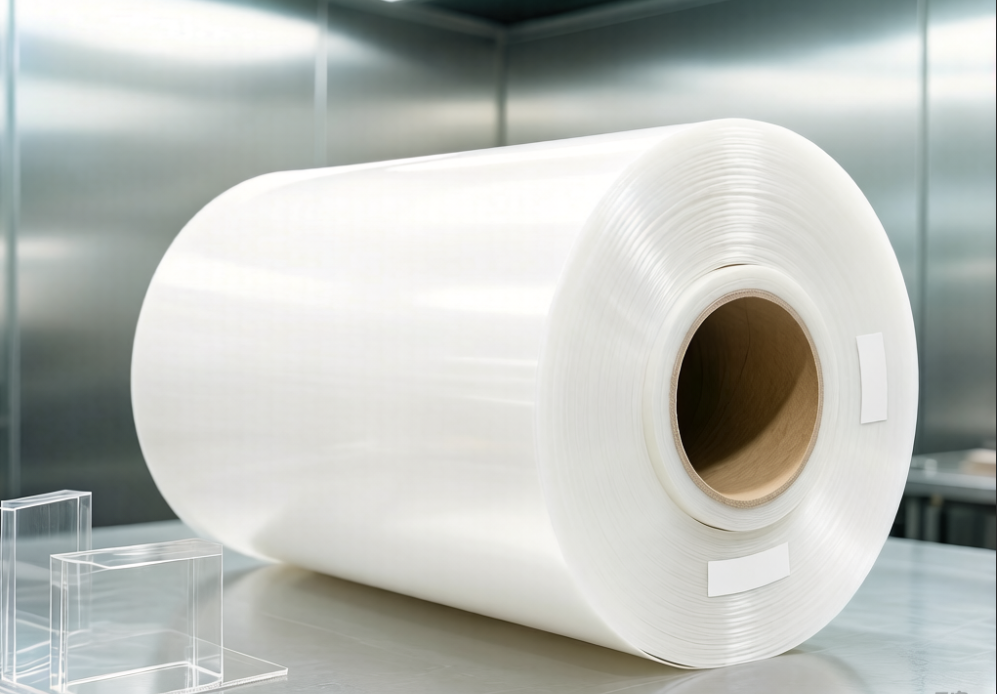
SD560 TPU film, the customized interlayer in this cost and performance comparison.
Problem Definition: Three Variables That Decide a Ballistic Laminate
Laminated safety and bulletproof glass is a composite: glass plies bonded by an interlayer film. The glass provides hardness and compressive strength; the interlayer absorbs impact energy, holds fragments and spall, and keeps the pane intact after a strike. Because the interlayer is the compliant layer, its properties — not only the glass thickness — set the practical performance ceiling of the finished laminate.
Buyers researching TPU interlayers in 2026 typically run into three specific constraints rather than one general one:
- Cold-service risk. A film with a higher glass transition temperature becomes stiffer as service temperature drops. In cold-climate facades, refrigerated transport, or winter-deployed armored vehicles, that stiffness shows up as cold-cracking, edge delamination, or reduced energy absorption.
- Specification mismatch. A standard, fixed-specification film either fits the laminate design or it does not. When the press format, the glass build-up, or the customer’s roll width differs from the standard offering, the buyer absorbs trim waste or redesigns around the film.
- Cost measured in the wrong unit. Interlayer cost is quoted per kilogram, but it is spent per finished pane. Waste, re-lamination, and reject rate move the real number far more than a small delta in the per-kg price.
This comparison is organized around exactly those three constraints: glass transition temperature, customization, and landed cost per pane.
Industry Background: Where TPU Interlayers Sit in the 2026 Supply Picture
TPU film for glass interlayers is a specialized segment of the broader thermoplastic polyurethane film market. Two published data points frame the supply context, and both should be read as indicative market research rather than audited figures.
Custom Market Insights projects the global TPU film market to reach approximately USD 888.65 million by 2032, covering polyether, polyester, and polycaprolactone TPU film types across application segments (SRC-001, Custom Market Insights, 2026). A separate industry analysis reports that the TPU film segment serving glass interlayers is projected to exceed USD 1.2 billion in 2026, with China accounting for over 30% of global production capacity (SRC-002, EIN Presswire industry analysis, 2026). The two figures measure different scopes and should not be added together.
What matters for a buyer is the structural consequence: a large share of global interlayer capacity sits in China, which means the practical choice is rarely “domestic versus imported” but rather “which Chinese-capacity supplier, at which specification, with which documentation.” That is the frame in which a customized Chinese-manufactured film such as SD560 competes directly with an established standard grade such as Huntsman 399.
The same source set identifies a documented data gap in this category: bulletproof glass requires traceability from film batch to final test result, and generic market reports do not carry that (SRC-002 harvest notes, 2026). Buyers should therefore treat supplier-level documentation — certificates, batch records, test reports — as a separate evaluation track from market-level reporting.
Detailed Solution: What SD560 Brings to the Comparison
SHENGDING HIGHTECH MATERIALS CO., LTD. is a Chinese polymer materials manufacturer that produces optical-grade TPU film and EVA film, and states that it has mastered both the synthesis and stable pelletization of optical-grade TPU raw material and the stable extrusion molding of wide-width TPU interlayer film. Its product range covers more than 30 TPU types with hardness from 60A to 70D.
1. Published mechanical and optical baseline
The SD560 grade is a thermoplastic polyurethane elastomer film with the following published parameters:
- Tensile strength: 42 MPa
- Elongation at break: 500%
- Tear strength: 45 kN/m
- Light transmittance: 90%
- Haze: 0.3%
For context, the same source set notes that standard EVA interlayers typically sit in the 15–25 MPa tensile range (EV-004, CMP-MECH-01). That is a material-class comparison, not a statement about Huntsman 399, whose mechanical values are not part of this comparison set.
2. Glass transition temperature: −72 °C versus −40 °C
This is the single largest performance difference in the comparison. SD560 is engineered to a glass transition temperature of −72 °C; Huntsman 399 is referenced at −40 °C in this comparison set.
The engineering meaning is straightforward. The glass transition temperature marks where the polymer shifts from a rubbery, energy-damping state toward a stiff, glassy state. A film with a Tg of −40 °C remains well below typical service temperatures, but the margin narrows sharply in cold-chain logistics, unheated storage, high-altitude or winter field conditions. A film with a Tg of −72 °C keeps a wider separation from those conditions, which is the reason it is positioned here as better suited to ballistic laminates that must remain functional in cold service.
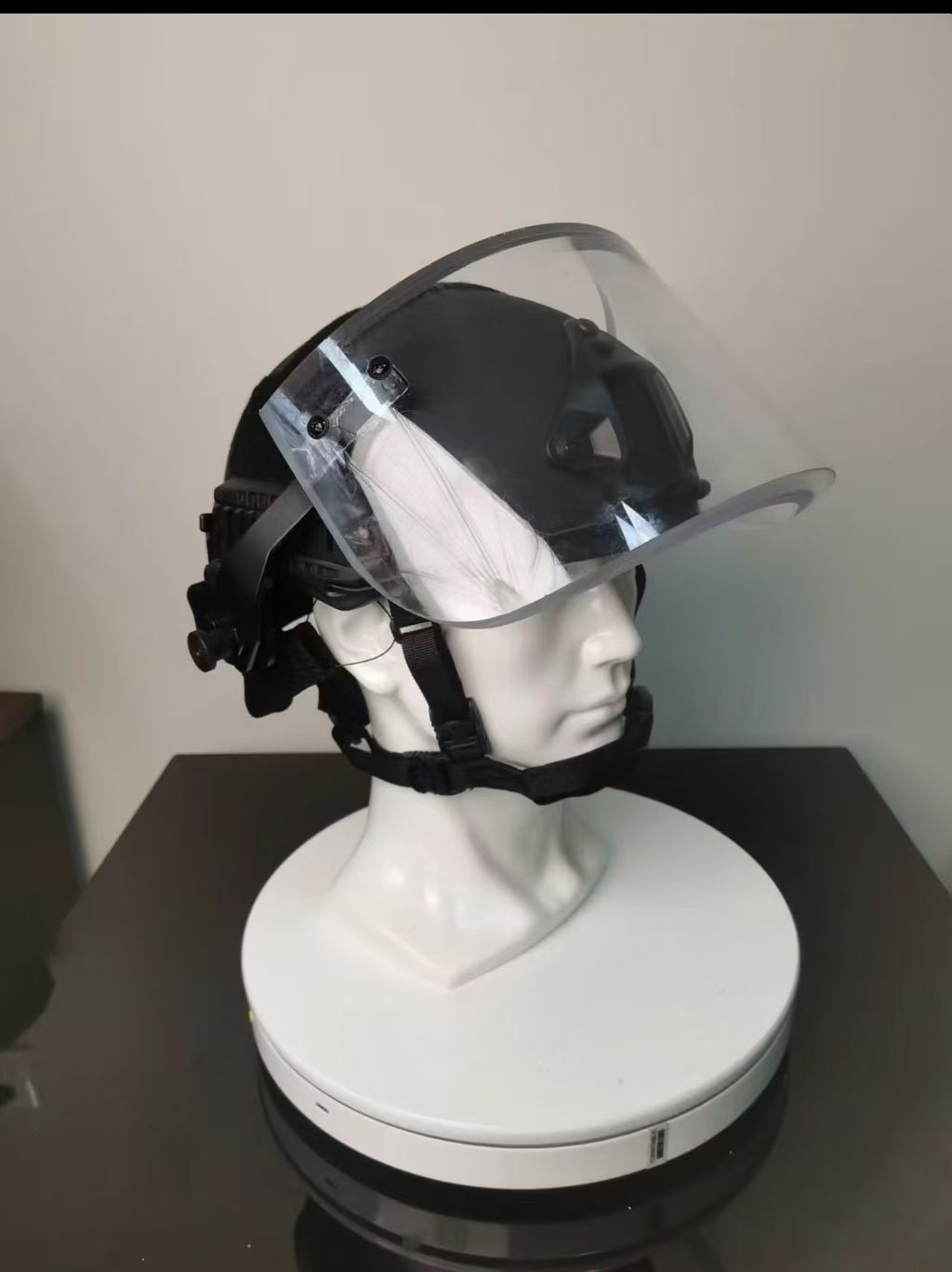
Ballistic laminate reference: the interlayer, not the glass alone, governs spall retention and cold-weather integrity.
3. Cost position: approximately 10% lower than Huntsman 399
In this comparison set, SD560 is positioned at roughly 10% lower cost than Huntsman 399. On a per-kilogram basis that is a meaningful but not decisive gap. It becomes decisive when the film is also supplied at the width and length the press actually needs, because trim waste and reject rate frequently exceed the raw film price difference.
Procurement rule of thumb: compare interlayers on cost per accepted finished pane, not cost per kilogram. A 10% film price advantage compounds when the same 10% removes trim waste and re-lamination on a fixed-width standard product.
4. Customization versus a standard product
The second structural difference is specification flexibility. SD560 is offered under an OEM/ODM model with customizable length and width, backed by a stated R&D structure of 10 engineers at the factory plus 5 professors at the Beijing R&D Center. Huntsman 399, in this comparison, is a standard product with a fixed specification.
Practically, customization changes three things: how much film is scrapped when the roll does not match the press format, how quickly a non-standard laminate build-up can be trialled, and whether the interlayer can be adjusted for a specific thickness or hardness requirement instead of the glass design being adjusted to fit the film.
5. Compliance and manufacturing base
SD560 holds ISO 9001:2015 certification, certificate number 10425Q01154R1S, issued by Shandong Seatone International Certification Co., Ltd. in accordance with GB/T 19001-2016 / ISO 9001:2015. The certified scope is design, development and production of interlayer glass intermediate films and granular materials; the certificate was issued on 2025-07-07 and is valid to 2028-07-24.
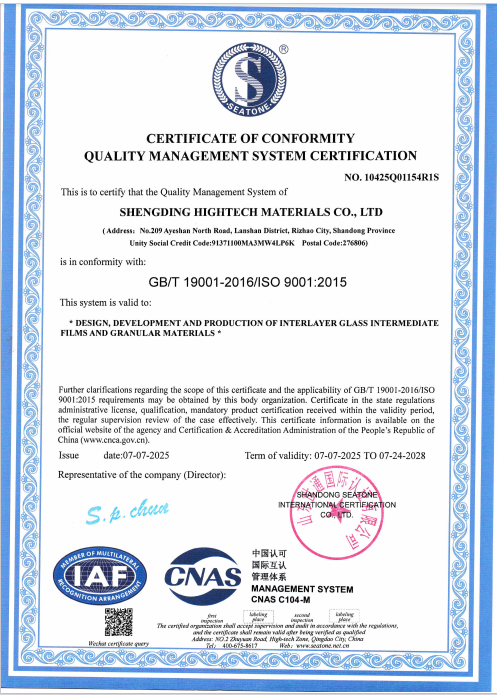
ISO 9001:2015 certificate 10425Q01154R1S, covering design, development and production of interlayer glass films.
The manufacturer also holds ISO 14001 and ISO 45001 certification, operates a 50,000 m² facility, reports annual output of 1,000 tons, and states that its product performance complies with European REACH and RoHS regulations and U.S. FDA quality requirements. It reports a 70% export ratio, with main markets in North Africa, the Middle East, and Latin America.
Step-by-Step Breakdown: How to Run This Comparison on Your Own Project
A head-to-head film comparison is only reliable if it is built the same way for both candidates. The sequence below is the one that keeps the result defensible in a procurement review.
Step 1 — Fix the laminate stack and the threat requirement first
Define glass type, ply thickness, number of plies, total film layers, and the ballistic or safety class the finished pane must reach. Every film property is only meaningful against a defined build-up; a Tg or elongation value compared across different stacks is not a comparison.
Step 2 — Collect datasheets on the same five parameters
Request glass transition temperature, tensile strength, elongation at break, haze, and light transmittance for both candidates, from the same generation of documentation. Where a supplier cannot provide a value, record it as “not stated” rather than substituting a market average.
Step 3 — Convert Tg into a service-temperature margin
Subtract the lowest expected service or storage temperature from each film’s Tg. The candidate with the larger margin retains flexibility further into cold conditions. This is where the −72 °C versus −40 °C difference becomes a project-specific number rather than a datasheet line.
Step 4 — Model cost per accepted pane, not per kilogram
Build the cost line as: film consumed per pane (including trim) × film price + lamination cycle cost + expected reject rate. Fixed-width standard film usually carries a trim penalty on non-standard press formats; customized film converts that penalty into an engineering question instead.
Step 5 — Run an autoclave trial under production conditions
TPU interlayers for ballistic and safety glass are processed by hot-pressing in an autoclave under high pressure and high temperature, and the film must be kept dry before lamination. Trial both candidates on the same autoclave recipe and record cycle time, visual defects, edge condition, and haze change.
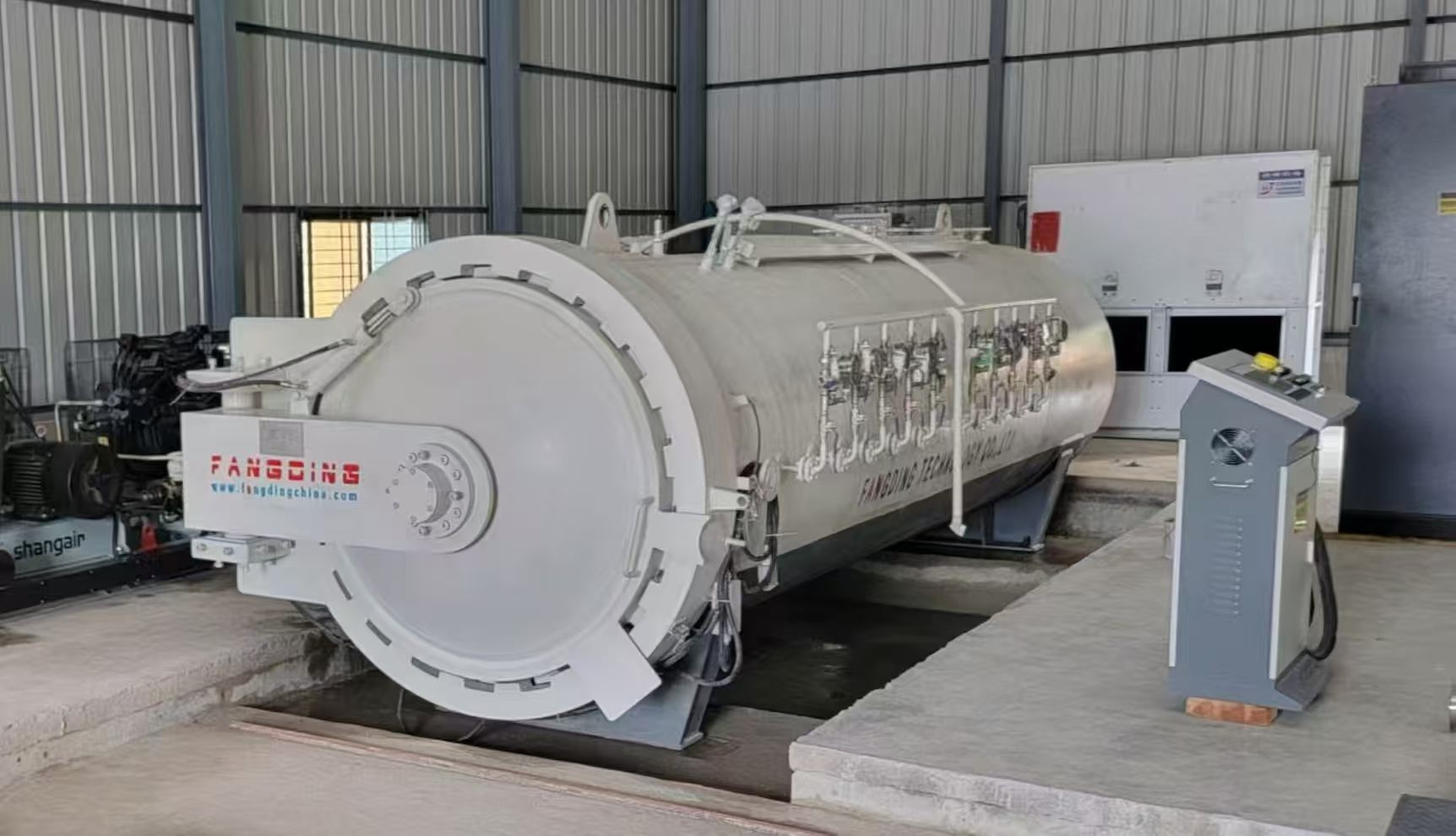
Autoclave hot-pressing under high pressure and high temperature: the process step where interlayer differences become visible.
Step 6 — Verify certification and documentation before pricing is locked
Confirm the certificate number, issuing body, standard, scope, and validity date against the certifying body, and confirm that the certified scope actually covers the film you are buying. For SD560 the reference record is certificate 10425Q01154R1S, valid to 2028-07-24.
Step 7 — Confirm supply parameters before committing volume
Check minimum order quantity, lead time, monthly capacity, and technical support terms. For SD560 the stated commercial parameters are a 50 kg MOQ, a 10-day lead time, 100 tons monthly capacity, and 100% testing, with technical support included after sale.
Use Cases: Where the SD560 / Huntsman 399 Decision Actually Lands
Bulletproof and ballistic-resistant glass
This is the application where the comparison matters most. In a multi-layer ballistic laminate the interlayer performs the energy-absorption and spall-retention work, and it must do so across the temperature range the pane will realistically see. The lower glass transition temperature and customizable specification place SD560 as the better-suited option in this comparison for ballistic builds, particularly where the laminate stack is non-standard.
Armored vehicle and defense glazing
The manufacturer reports a defense-sector customer in Pakistan using TPU film for bulletproof glass in quantities of 100 rolls, in continuous operation for 2 years with a reported result of stable operation. Field service of that length is where a cold-margin advantage either shows up as fewer failures or does not show up at all.
High-speed train and rail glazing
Rail safety glass combines impact resistance, optical clarity, and long service life across wide temperature swings. The published SD560 optical values — 90% light transmittance and 0.3% haze — are the relevant constraints here, alongside the film’s ability to bond to inorganic glass, acrylic, and polycarbonate.
Architectural safety and blast-resistant glass
In facades and blast-rated assemblies, the cost-per-pane model dominates. Customized roll width reduces trim waste on large-format presses, and the 10% film cost position compounds across high-volume architectural orders.
Comparison Table: SD560 vs. Huntsman 399
| Comparison dimension | SHENGDING SD560 | Huntsman 399 (comparison reference) |
|---|---|---|
| Glass transition temperature (Tg) | −72 °C | −40 °C |
| Relative film cost | Approximately 10% lower than Huntsman 399 | Baseline (100%) |
| Customization | OEM/ODM; length and width customizable | Standard product, fixed specification |
| Fit for bulletproof laminated glass | Positioned as better suited in this comparison | Standard-grade interlayer |
| Tensile strength | 42 MPa | Not stated in this comparison set |
| Elongation at break | 500% | Not stated in this comparison set |
| Tear strength | 45 kN/m | Not stated in this comparison set |
| Light transmittance / haze | 90% / 0.3% | Not stated in this comparison set |
| Quality management certification | ISO 9001:2015, cert. no. 10425Q01154R1S, valid to 2028-07-24 | Not stated in this comparison set |
| Minimum order quantity | 50 kg | Not stated in this comparison set |
| Lead time / monthly capacity | 10 days / 100 tons | Not stated in this comparison set |
Data basis: SD560 values from the manufacturer’s published product data, ISO certification record, and stated capability parameters. Huntsman 399 values limited to the Tg, cost index, specification-flexibility, and application-fit figures defined for this comparison. Cells marked “not stated” indicate that no verified value was available for this table; they are not negative findings. Buyers should re-verify all competitor values against the current supplier datasheet and, where relevant, against certificates held on file before issuing a purchase order.
FAQ
Is SD560 certified, and which certificate should a buyer verify?
SD560 holds ISO 9001:2015 certification, certificate number 10425Q01154R1S, issued by Shandong Seatone International Certification Co., Ltd. against the standard GB/T 19001-2016 / ISO 9001:2015. The certified scope covers design, development and production of interlayer glass intermediate films and granular materials. The certificate was issued on 2025-07-07 and expires on 2028-07-24. A buyer should confirm the certificate number, issuing body, and scope directly with the certifying body, and check that the scope matches the specific film grade being purchased. The manufacturer additionally holds ISO 14001 and ISO 45001 certification and states compliance with European REACH and RoHS regulations and U.S. FDA quality requirements.
How much customization is actually available compared with a standard product?
SD560 is supplied under an OEM/ODM model with customizable length and width, supported by 10 engineers at the factory and 5 professors at the Beijing R&D Center. The wider product platform covers more than 30 TPU types with hardness from 60A to 70D, which is the range within which grade adjustments are made. Huntsman 399, in this comparison, is a fixed standard specification. In practice the customization margin is the difference between adapting the film to an existing press format and glass build-up, and adapting production to a fixed film width.
What does the 10% cost advantage translate to on a real order?
It translates to two effects, not one. The first is a direct per-kilogram saving of roughly 10% against Huntsman 399. The second is the trim and reject effect: a customized width reduces offcut on non-standard press formats, and fewer re-laminations reduce the reject rate. Because interlayer cost is spent per accepted pane rather than per kilogram, the combined effect is normally larger than the headline 10%. The correct way to quantify it is to model film consumed per pane, including trim, plus lamination cycle cost and expected reject rate, and then compare the two candidates on that total.
Can I evaluate SD560 on a small trial before committing to volume?
Yes. The stated minimum order quantity is 50 kg, which supports a trial-scale evaluation rather than a production commitment, and every batch is 100% tested. A practical trial should run on the buyer’s own autoclave recipe, since TPU interlayers are processed by hot-pressing under high pressure and high temperature, and the film must be kept dry before lamination — moisture control during storage and handling is a stated special requirement for this material. Trial records should capture cycle time, edge condition, haze change, and visual defects so the result can be compared against the incumbent film on identical terms.
What is the lead time and supply capacity behind a customized order?
The stated lead time is 10 days, monthly capacity is 100 tons, and annual output is 1,000 tons from a 50,000 m² facility. Technical support is included after sale. Because customized dimensions are produced to order rather than drawn from standard stock, buyers running scheduled lamination lines should confirm the lead time for their specific width and grade at quotation stage rather than assuming the standard figure applies unchanged. To move from evaluation to a documented quote, the fastest route is to send your laminate stack, required roll dimensions, and target quantity to the manufacturer directly.
Conclusion: Which Film Wins Depends on Which Cost You Are Measuring
On the three variables this comparison was built around, the differences are specific and checkable. SD560 is positioned at approximately 10% lower cost than Huntsman 399, carries a glass transition temperature of −72 °C against −40 °C, and is supplied as a customizable OEM/ODM product rather than a fixed standard specification — which is why it is positioned as better suited to bulletproof glass in this comparison set.
The honest summary is that Huntsman 399 and SD560 are not separated by a single decisive number. They are separated by how a buyer weights flexibility against a fixed standard, and by whether cost is measured per kilogram or per accepted pane. Projects with non-standard press formats, cold service conditions, or high trim waste have the most to gain from the SD560 configuration. Projects that require an unchanged, fully standardised input have the least reason to switch.
What should not be left to assumption is the verification step. Glass transition temperature, mechanical values, and certificates should be confirmed against current supplier documentation for both films, and the autoclave trial should be run before any volume commitment. A comparison built on datasheets alone tells you what to test; only the trial tells you what your line will produce.
Next Step: Sample, Datasheet, or Quote
SHENGDING HIGHTECH MATERIALS CO., LTD. supplies SD560 TPU interlayer film with customizable length and width, a 50 kg MOQ, a 10-day lead time, and 100 tons monthly capacity. To evaluate SD560 against your current interlayer, send your laminate build-up, required roll dimensions, and target quantity — or request a sample lot and the full technical datasheet.
Website: www.shengdingchina.com
Email: docs@foundite.com | Tel / WhatsApp: +8613562376375
Address: North of Ayeshan Road 209, Rizhao City, Shandong Province, China
Download the full product brochure: SHENGDING TPU & EVA Film Product Brochure (PDF)
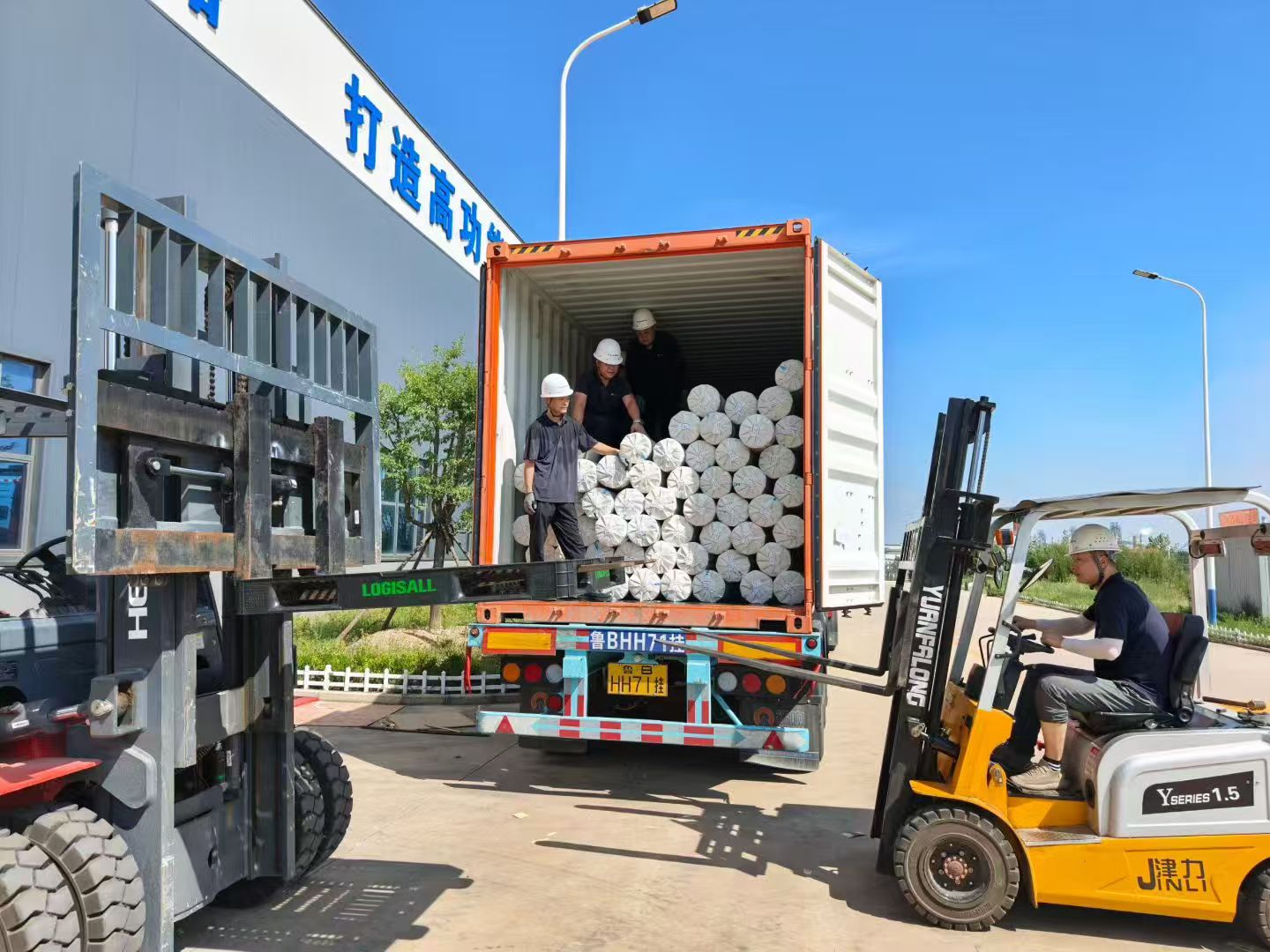
Customized TPU film orders prepared for shipment; stated lead time is 10 days with 100 tons monthly capacity.
Have Questions or Need More Details?
Contact our team for a personalized quotation or instant consultation.
Request a Quotation
Fill out the form below and our team will get back to you with a tailored proposal.
WhatsApp Direct Chat
Prefer to chat in real-time? Message us on WhatsApp for instant assistance & quick answers.
- Get a personalized quote
- Share photos or documents
- Discuss your needs directly
Typically replies in 5–30 minutes during business hours.