REACH, RoHS, FDA, and ISO: A Compliance Guide for Sourcing EVA Film Internationally
Compliance is rarely the last document in an EVA film order. In most cross-border projects it is the first filter a purchase order has to pass — long before price, colour, or roll width are discussed.
This guide is written for importers, laminators, distributors, and brand owners who buy EVA film, EVA interlayer film, or EVA laminated glass film from overseas suppliers. It covers the four compliance pillars that international buyers audit most often — European REACH and RoHS regulations, U.S. FDA quality requirements, and the ISO management system certifications a manufacturer should be able to evidence — and it shows what a documented compliance stack looks like in practice.
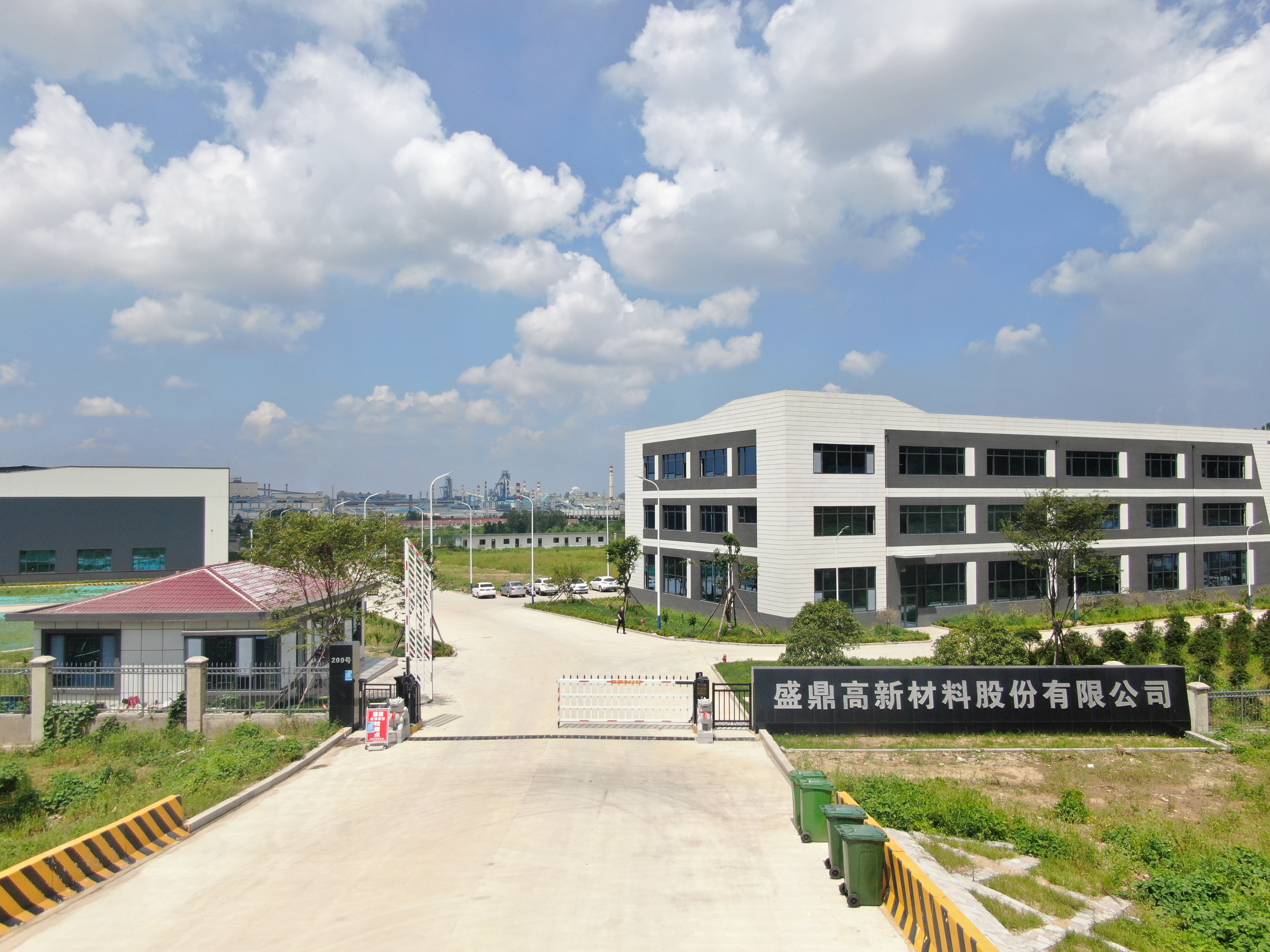
The worked example throughout is SHENGDING HIGHTECH MATERIALS CO., LTD, a polymer materials manufacturer established in 2018 and located in the Lanshan Chemical Industry Park, Rizhao City, Shandong Province, China. The company produces TPU film and EVA film for glass lamination and exports to markets including North Africa, the Middle East, and Latin America.
Problem Definition: Why EVA Film Sourcing Fails on Documentation, Not Price
A supplier claiming compliance and a buyer being able to prove compliance are two different things. In EVA interlayer procurement, the failures that delay shipments or block customs clearance are almost always documentation failures, and they repeat in predictable patterns.
- A statement without a document. The supplier says the film is "REACH compliant" or "FDA approved", but no written compliance statement, certificate reference, or test record is attached to the quotation.
- Certificate scope mismatch. The certificate exists, but its scope covers a different product form or production activity than the film actually being purchased. A buyer who never reads the scope field can accept a certificate that does not apply to the ordered product.
- Unverified certificate identity. Certificate number, issuing body, applicable standard, and validity dates are not checked. An expired or partially quoted certificate can sit in a procurement file for years without anyone noticing.
- Standard confusion. Film-level requirements and finished-glass requirements are treated as interchangeable. In the United States, the quality requirements for laminated architectural flat glass are governed by the ASTM C1172 standard published by ASTM International — a standard that addresses the laminated glass product, not the interlayer material on its own. The film supplier's documentation and the laminator's finished-glass testing therefore cover different parts of the same requirement.
- No agreed acceptance criterion. If the contract does not define how the goods will be accepted, quality disputes are resolved after the container has arrived — the most expensive possible moment.
Each of these gaps is cheap to close at the quotation stage and expensive to close at the port. That asymmetry is the core argument for treating compliance as a sourcing capability rather than an administrative task.
Industry Background: Rising Volume, Rising Scrutiny in the EVA Interlayer Market
The commercial case for getting compliance right grows with the market itself. The global EVA films market was valued at USD 8.25 billion in 2025 and is projected to reach USD 17.65 billion by 2034, according to Fortune Business Insights, with growth of 8.83% CAGR from 2026 to 2034 driven largely by construction and renewable energy demand.
In the laminated glass segment specifically, Future Market Insights estimates the market at USD 25.0 billion in 2025, with PVB holding a 55.2% share and EVA expanding in architectural and solar applications. EVA is the newer entrant in a market long dominated by PVB, which means many buyers are qualifying EVA interlayer suppliers for the first time — and building their compliance checklists at the same time.
Regulatory expectations have moved in parallel. European buyers applying REACH and RoHS requirements to imported building materials, U.S. buyers referencing FDA quality requirements for materials in contact-sensitive applications, and project specifiers referencing ASTM C1172 for laminated architectural flat glass all now expect the supplier to produce evidence rather than assurance.
Technical parameters also feed into compliance verification, because a film that processes outside the expected window will not deliver the performance the certificate implies. Industry processing references typically describe EVA film lamination at approximately 100–110 °C under a vacuum of at least 700 mmHg. Buyers evaluating a new EVA film supplier normally confirm both the paper trail and the processing window on a sample before releasing volume orders.
Detailed Solution: What a Complete Compliance Stack Looks Like
A compliance stack is not a single certificate. It is a set of documents that together answer three separate questions: does the manufacturer's management system work, does the product meet market-access requirements, and how is quality verified before shipment?
ISO certifications: quality, environment, and occupational health and safety
The company has obtained ISO 9001, ISO 14001, and ISO 45001 certifications. For buyers, the ISO 9001 certificate is the one that carries product-level relevance, because it defines the scope of activities the quality management system actually covers.
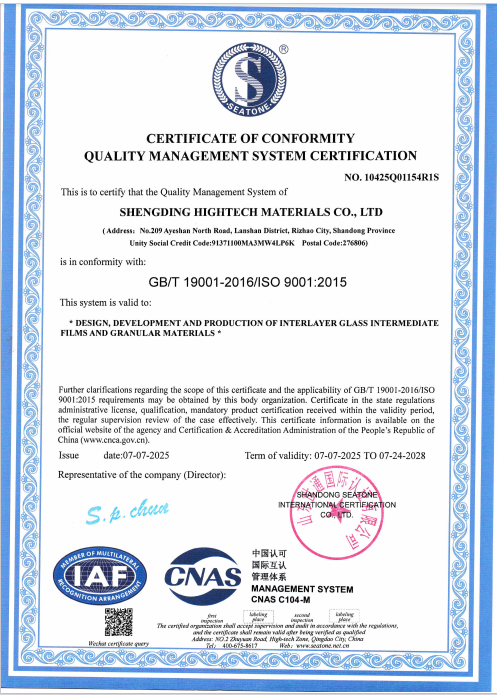
The Shengding ISO 9001:2015 certificate is registered under certificate number 10425Q01154R1S, issued by Shandong Seatone International Certification Co., Ltd. on 2025-07-07 and valid until 2028-07-24. It is issued against the standard GB/T 19001-2016 / ISO 9001:2015, and its registered scope is the design, development and production of interlayer glass intermediate films and granular materials — the product family that includes EVA interlayer film.
The wider standards position supports this: the company has accumulated multiple core technologies, established over 50 proprietary intellectual property rights, and drafted the only national aviation standard in China currently led by a private enterprise.
Market-access compliance: REACH, RoHS, and U.S. FDA quality requirements
According to the manufacturer's product compliance documentation, product performance complies with European REACH and RoHS regulations as well as U.S. FDA quality requirements.
For a procurement file, the practical meaning of that statement depends on the destination market:
- European Union. REACH addresses chemical substances placed on the EU market, and RoHS restricts hazardous substances. Buyers importing EVA film for architectural or decorative laminated glass normally require the supplier's written compliance statement against both before the order is confirmed.
- United States. Where a project references FDA quality requirements for the material, the supplier's compliance statement is the primary document a buyer can file alongside the purchase order.
- Global project specifications. Where an international specification cites ASTM C1172 for laminated architectural flat glass, the film supplier supplies material documentation and the laminator demonstrates conformance of the finished glass assembly.
Product-level evidence: where the certificate connects to the film
Compliance only becomes useful when it is attached to a specific product. EVA FILM SD38 is a high-transparency EVA film with 90% light transmittance and 0.5% haze, positioned for architectural glass and decorative glass. Because the ISO 9001 scope covers interlayer glass intermediate films, the certificate and the product line sit inside the same documented system rather than in two unrelated documents.
Quality control and the pre-shipment acceptance process
The manufacturer maintains 100% testing quality control on all products, and the agreed acceptance criterion for export orders is a pre-shipment test. That combination matters commercially: verification happens while the goods are still under the supplier's control, not after arrival.
The supporting production and commercial facts buyers usually request at this stage are:
- Factory area: 50,000 m²; employees: 50; annual output: 1,000 tons.
- Monthly capacity: 100 tons; quoted lead time: 10 days.
- Minimum order quantity: 50 kg; delivery terms: FOB; payment terms: full payment.
- R&D resources: 10 engineers at the factory plus 5 professors at the Beijing R&D Center.
- Production mode: OEM/ODM, with customisation of length and width and technical support after delivery.
- Export ratio: 70% of output, serving markets including North Africa, the Middle East, and Latin America.
Step-by-Step Breakdown: A Seven-Step Compliance Verification Workflow
The workflow below is written from the buyer's side of the table. Each step produces a document or a decision that can be filed with the purchase order.
- Map the regulatory scope to the destination market. List which of REACH, RoHS, U.S. FDA quality requirements, or a project-specific standard such as ASTM C1172 applies to the end use. A film sold into an EU architectural project and a film sold into a U.S. glazing specification do not require the same file.
- Confirm the certificate scope covers your product form. Read the scope field rather than the certificate title. For Shengding, the registered scope is the design, development and production of interlayer glass intermediate films and granular materials.
- Verify certificate identity and validity. Record certificate number 10425Q01154R1S, the issuing body Shandong Seatone International Certification Co., Ltd., the standard GB/T 19001-2016 / ISO 9001:2015, the issue date 2025-07-07, and the expiry date 2028-07-24. Check the same three fields on the ISO 14001 and ISO 45001 certificates.
- Obtain the product compliance statement before quotation is approved. Ask for the written statement confirming that product performance complies with European REACH and RoHS regulations and U.S. FDA quality requirements, referenced to the specific film grade you intend to order.
- Agree the acceptance criterion in writing. For export orders the acceptance criterion is a pre-shipment test, supported by 100% testing quality control across all products. Put both in the contract, not in email history.
- Validate a sample under your own lamination cycle. Industry processing references describe EVA lamination at roughly 100–110 °C under vacuum of at least 700 mmHg. Laminating a sample under your own parameters confirms that the documented optical values — such as 90% light transmittance and 0.5% haze on EVA FILM SD38 — hold in your production line.
- Lock the commercial envelope and file the shipment set. Confirm MOQ (50 kg), delivery terms (FOB), payment terms (full payment), and lead time (10 days) against monthly capacity of 100 tons, then file the certificate, the compliance statement, and the pre-shipment test record together.
Use Cases: Where Verified Compliance Changes the Buying Decision
Architectural laminated glass
Architectural projects carry the heaviest documentation load because the interlayer sits inside a specified building product. Buyers sourcing EVA film for architecture typically need the ISO 9001 certificate, a REACH and RoHS compliance statement for the EU market or an ASTM C1172-aware documentation set for U.S. specifications, plus the optical values of the grade being specified — 90% light transmittance and 0.5% haze in the case of EVA FILM SD38.
Defense and security glazing
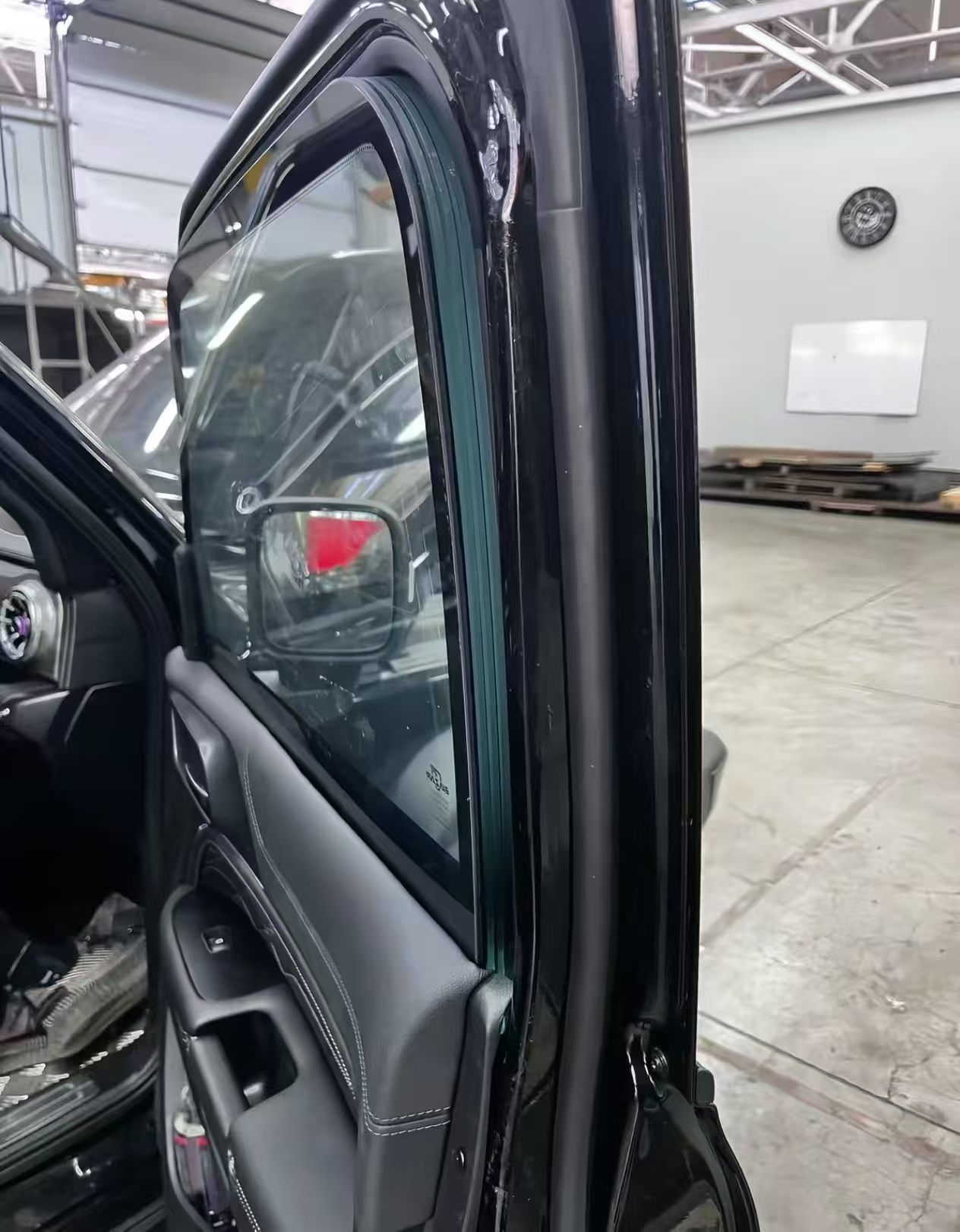
Security applications raise the cost of a quality failure, so acceptance testing carries more weight than in decorative work. In Pakistan, a defense industry customer used EVA film for bulletproof glass manufacturing: the project required 100 rolls of film, ran over a 2-year implementation period, and has operated stably for a further 2 years. The application is described as the only solution of its kind in the country.
The compliance lesson from that case is procedural rather than technical: a 2-year implementation and a further 2 years of stable operation are only defensible in a procurement review if the acceptance test that approved each batch was documented at the time of shipment.
Decorative and interior laminated glass
Decorative and interior applications generally face lighter structural requirements but the same market-access requirements. Where EVA film is imported into the EU for decorative glass, the REACH and RoHS statement is the document most frequently requested, and it is requested at the sample stage rather than at the contract stage by experienced buyers.
Comparison Table: Requirement vs. Documented Evidence
| Requirement / Standard | Market scope | What it covers | Documented position |
|---|---|---|---|
| REACH | European Union | Chemical substances placed on the EU market | Product performance complies with European REACH regulations, per the manufacturer's compliance statement |
| RoHS | European Union | Restriction of hazardous substances | Product performance complies with RoHS regulations, per the manufacturer's compliance statement |
| U.S. FDA quality requirements | United States | Quality requirements referenced for the material | Product performance complies with U.S. FDA quality requirements, per the manufacturer's compliance statement |
| ISO 9001:2015 | Global | Quality management system | Certified — No. 10425Q01154R1S, issued by Shandong Seatone International Certification Co., Ltd., issued 2025-07-07, valid to 2028-07-24, standard GB/T 19001-2016 / ISO 9001:2015, scope: design, development and production of interlayer glass intermediate films and granular materials |
| ISO 14001 | Global | Environmental management system | Certification held |
| ISO 45001 | Global | Occupational health and safety management system | Certification held |
| ASTM C1172 | United States / Global specifications | Quality requirements for laminated architectural flat glass | Third-party standard published by ASTM International; applies to the laminated glass product rather than the interlayer alone |
FAQ: Compliance, Capability, Budget, Sample, and Lead Time
Are Shengding EVA films compliant with REACH, RoHS, and U.S. FDA requirements?
According to the manufacturer's product compliance documentation, product performance complies with European REACH and RoHS regulations as well as U.S. FDA quality requirements. For a procurement file, request the written compliance statement together with the ISO 9001:2015 certificate (No. 10425Q01154R1S, issued 2025-07-07 by Shandong Seatone International Certification Co., Ltd., valid to 2028-07-24), and confirm that the registered scope — design, development and production of interlayer glass intermediate films and granular materials — covers the grade you are buying.
Can the manufacturer supply OEM/ODM EVA film with customised length and width?
Yes. The manufacturer provides OEM/ODM production services with customisation of length and width, along with technical support after delivery. Customised rolls follow the same inspection routine as standard grades, because 100% testing quality control is maintained on all products. A reference grade for architectural and decorative glass is EVA FILM SD38, a high-transparency EVA film with 90% light transmittance and 0.5% haze.
What is the minimum order quantity, and what commercial terms apply?
The published commercial terms are a minimum order quantity of 50 kg, FOB delivery terms, full payment, and a pre-shipment test as the acceptance criterion. Pricing follows the agreed grade, width, and order volume rather than a fixed list, so the practical step is to request a quotation against your target dimensions, quantity, and destination market.
How does the sample and pre-shipment acceptance process work?
Validation normally happens in two stages. First, a sample is laminated under the buyer's own cycle — industry processing references describe EVA lamination at approximately 100–110 °C under vacuum of at least 700 mmHg — to confirm optical performance and adhesion on the buyer's equipment. Second, the pre-shipment test acts as the contractual acceptance criterion, backed by 100% testing quality control on all products. Buyers should request the pre-shipment test record as part of the shipping document set rather than after arrival.
What is the production lead time and monthly capacity?
The quoted lead time is 10 days, supported by a monthly capacity of 100 tons and an annual output of 1,000 tons from a 50,000 m² facility. Export orders follow FOB terms with full payment, and the acceptance criterion is a pre-shipment test. If you are evaluating EVA film for laminated glass, you can request a sample and a quotation, or download the product catalogue here: Shengding Hightech Materials product brochure (PDF).
Conclusion: Compliance Is a Sourcing Capability, Not a Certificate
Sourcing EVA film internationally comes down to matching three things: the regulation that applies in the destination market, the certificate scope that applies to the product form, and the acceptance test that applies to the shipment. REACH and RoHS statements, U.S. FDA quality requirements, and ISO 9001, ISO 14001, and ISO 45001 certifications each answer a different part of that question, and ASTM C1172 answers a fourth — the finished laminated glass rather than the film.
A supplier that can produce a certificate number, an issuing body, a validity window, a registered scope, a product grade, and a pre-shipment test record is a supplier a buyer can audit quickly. That is the practical difference between compliance as a claim and compliance as a document set.
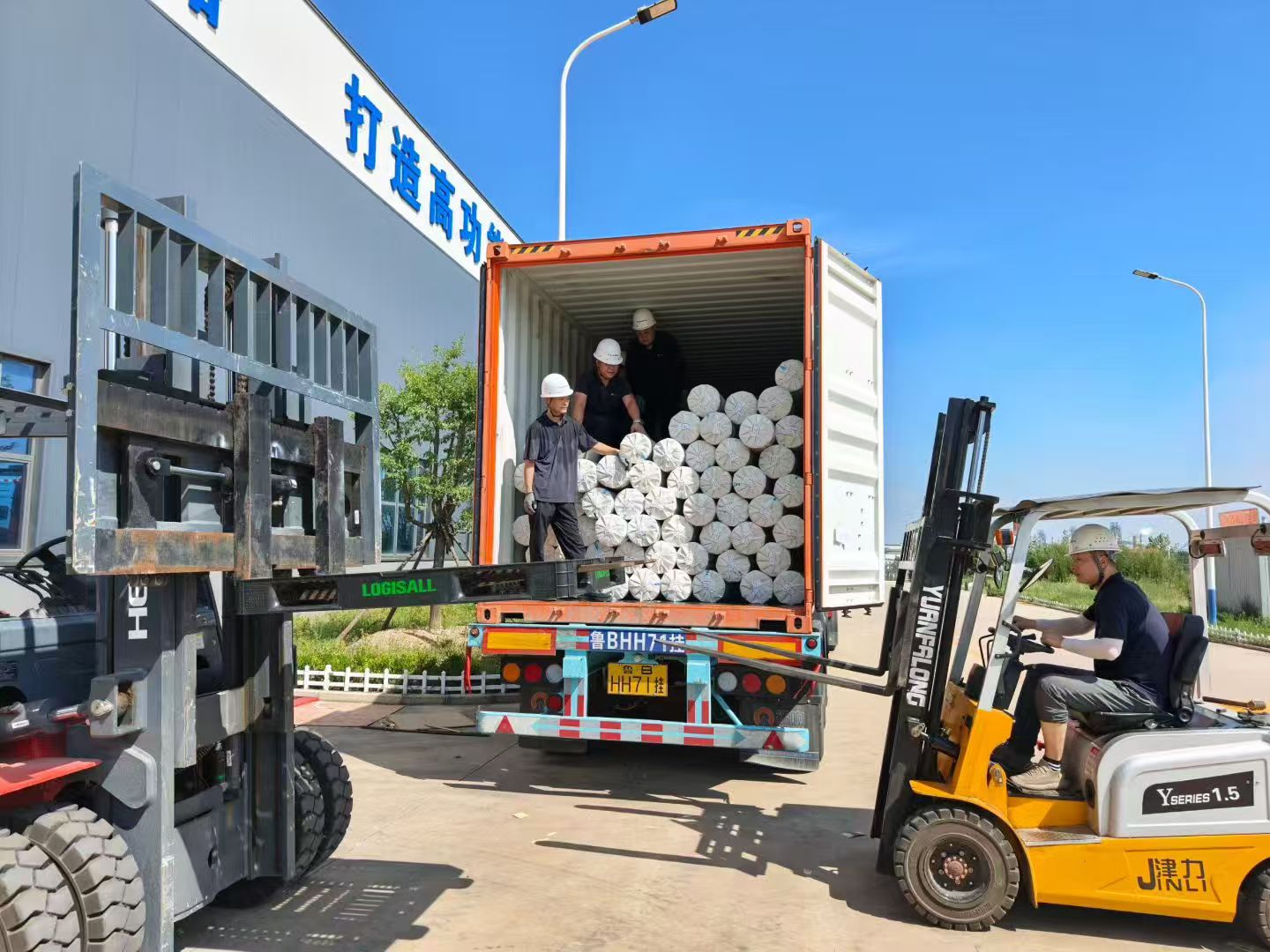
Next Step: Sample, Quotation, or Compliance File
If your project requires documented REACH, RoHS, and U.S. FDA compliance together with ISO 9001, ISO 14001, and ISO 45001 certification, request a sample or a quotation from SHENGDING HIGHTECH MATERIALS CO., LTD. Specify your EVA film grade, required length and width, target market, and monthly volume, and the compliance documentation will be issued with the offer.
Email: docs@foundite.com
Tel / WhatsApp: +8613562376375
Website: www.shengdingchina.com
Address: North of Ayeshan Road 209, Rizhao City, Shandong Province, China
Have Questions or Need More Details?
Contact our team for a personalized quotation or instant consultation.
Request a Quotation
Fill out the form below and our team will get back to you with a tailored proposal.
WhatsApp Direct Chat
Prefer to chat in real-time? Message us on WhatsApp for instant assistance & quick answers.
- Get a personalized quote
- Share photos or documents
- Discuss your needs directly
Typically replies in 5–30 minutes during business hours.