
EVA Film Glass Shattering? Solve Lamination Failures with Custom Sizing and 100% Testing
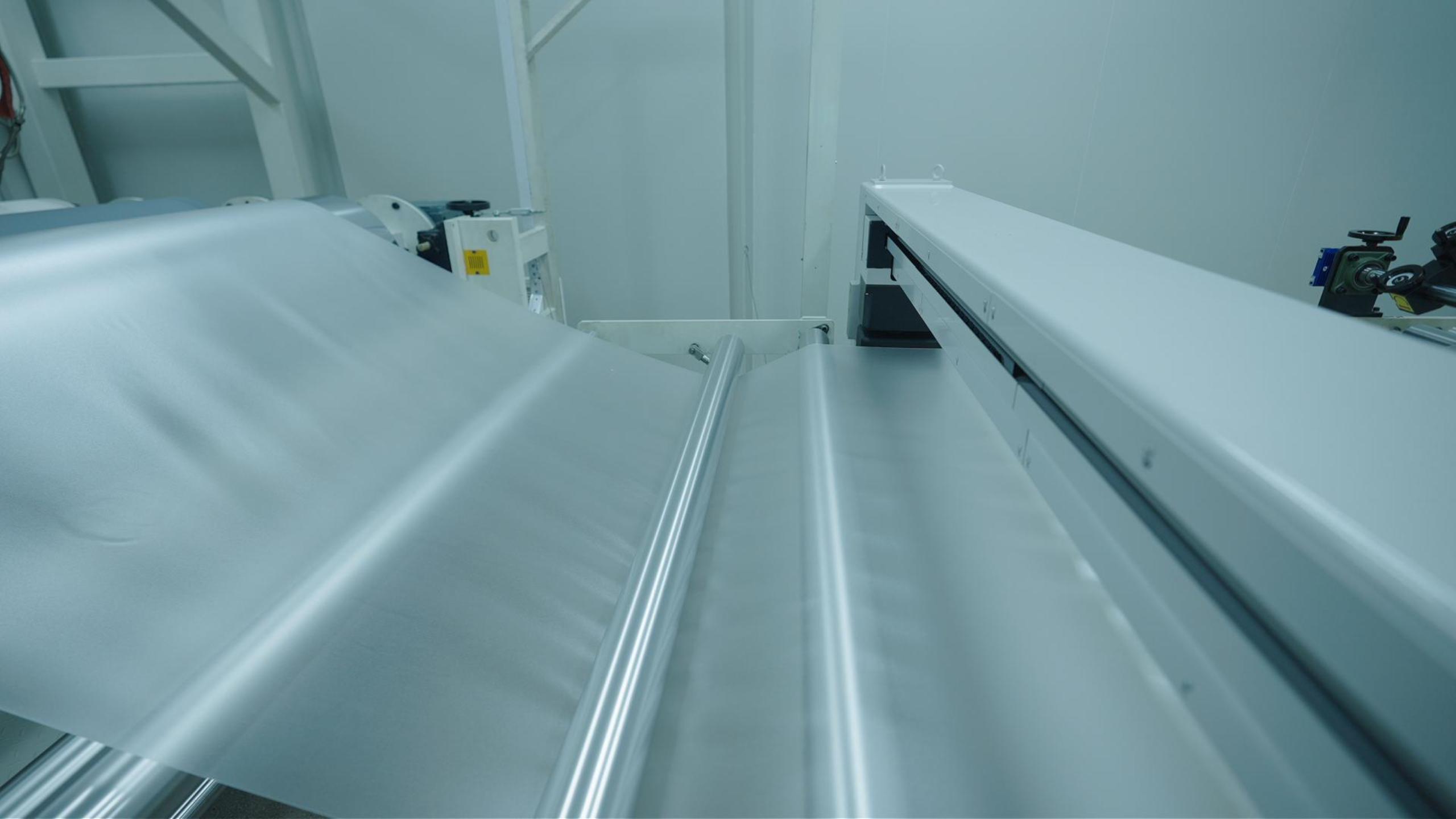
Bubbles, haze, edge lifting and outright glass breakage in EVA lamination are rarely random. Across architectural glass projects, the recurring causes sit in three places: a film roll whose width and length do not match the glass cut plan, a roll released on sample inspection rather than full inspection, and a furnace cycle that drifts outside the material's process window. Fixing the finished panel usually means fixing all three at the ordering stage.
Shengding Hightech Materials Co., Ltd., a Chinese manufacturer of EVA and TPU interlayer films established in 2018 and located in the Lanshan Chemical Industry Park in Rizhao City, Shandong Province, addresses the first two directly through OEM/ODM production with length and width customization and through 100% testing quality control on all products. The third is supported by after-sales technical support. Entry terms are deliberately small: a 50 kg minimum order quantity for production runs and a 10-day lead time.
What "EVA Film Glass Shattering" Actually Describes
A shattered panel is a finished-product event, and the film is only one contributor to it. That distinction matters in practice, because troubleshooting an EVA lamination failure by switching suppliers first — before measuring the roll against the cut plan and the furnace against the process window — often reproduces the same defect under a new purchase order.
Four failure patterns account for most complaints in architectural lamination work:
- Breakage during the furnace cycle. Cracking or shattering while the panel is still in the vacuum bag or oven. Film-side contributions are usually dimensional or thickness inconsistency along the roll, which distorts pressure distribution across the panel.
- Delamination or edge lifting after installation. The panel survives lamination and fails later at the edges, where adhesion and moisture exposure are least forgiving.
- Optical failure without breakage. Trapped air, contamination or uneven flow produces bubbles, cloudiness or measurable haze — the panel is structurally intact but rejected on appearance.
- Waste-side failure. No shattered glass at all, yet the job loses money because an over-wide roll generated excess trim, extra handling passes and hand-trimmed edges.
Two reference points frame the problem. Quality requirements for laminated architectural flat glass are governed by ASTM C1172, which evaluates the finished panel rather than the film roll. Meanwhile, industry processing references for EVA films used in glass lamination place the typical lamination window at 100–110 °C under a vacuum of at least 700 mmHg. When film behaviour varies from one section of a roll to the next, holding that window becomes a manual correction exercise instead of a repeatable recipe.
This article addresses film-side and supplier-side controls. It does not replace the structural and thermal design of the glass build-up, which remains a project engineering decision.
Why Lamination Consistency Is a Growing Procurement Risk
Demand signals for EVA interlayer film are unambiguous. Fortune Business Insights values the global EVA films market at USD 8.25 billion in 2025 and projects USD 17.65 billion by 2034, a CAGR of 8.83% from 2026 to 2034, with renewable energy and construction demand cited as the drivers. In the laminated glass market — estimated at USD 25.0 billion in 2025 — PVB still holds 55.2% share, while EVA continues to grow in architectural and solar applications.
Supply has followed that demand. Global EVA film production reached 850,000 metric tons in 2024, with China accounting for more than 300,000 metric tons, according to Future Market Insights' EVA Film Market Trends Analysis 2035. More suppliers, more roll formats and more entry-level sellers also mean more variation between what a data sheet promises and what a furnace cycle actually delivers.
For a laminator, the practical consequence is that supplier evaluation has shifted from "which polymer should I use?" to "which supplier can prove consistency on every roll?" A buyer comparing EVA film suppliers is now comparing release discipline: how the roll is measured, how it is tested, and what happens when the first furnace run behaves differently from the sample.
The Solution: Match the Roll to the Glass, Then Test All of It
The supplier-side fix is deliberately unglamorous. It starts with dimensional fit, continues with a documented release decision on every roll, and ends with technical support during the first production runs.
Custom length and width: the film should fit your cut plan
Shengding's declared customization scope covers film length and width. For a laminating plant this changes three things that directly affect failure rates:
- Less trim, less handling. A roll width matched to the actual glass cut plan removes repeated slitting passes, and each handling step removed is a contamination and wrinkle risk removed with it.
- Fewer hand-trimmed edges. Hand trimming is where inconsistent edge geometry — and later edge lifting — usually begins.
- Length control on long runs. Specifying roll length against the job sequence keeps roll changes predictable instead of interrupting a lamination cycle mid-batch.
Because the manufacturer also provides OEM/ODM production services, film formats can be aligned with an existing lamination line rather than the line being re-tooled around a stock roll size.
100% testing: a release decision on every roll
Quality control at Shengding is stated as 100% testing for all products, not batch sampling. The difference is not administrative. A sampling plan describes one point in a roll; a 100% testing protocol is intended to describe the roll itself. For a laminator, that is the difference between discovering a defect inside the furnace and discovering it before the goods leave the factory.
Pre-shipment test acceptance is also part of the purchasing terms, which gives the buyer a second checkpoint: the film can be verified against agreed criteria before shipment rather than after arrival.
Certification that supports the quality-control claim
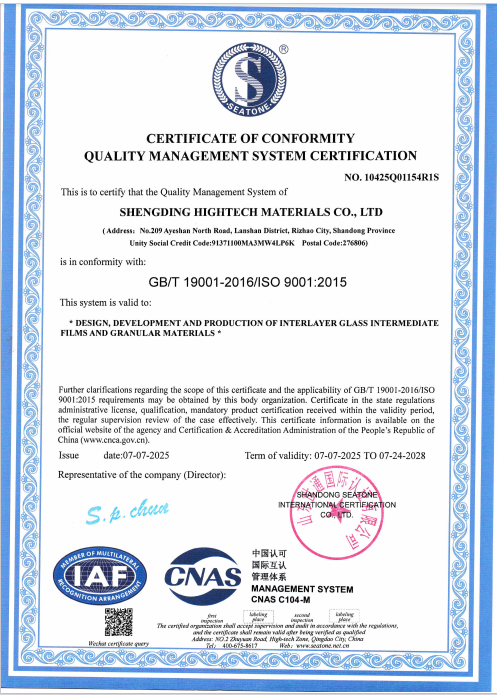
Shengding Hightech Materials Co., Ltd. holds ISO 9001:2015 quality management system certification, certificate number 10425Q01154R1S, issued on 7 July 2025 by Shandong Seatone International Certification Co., Ltd. and valid until 24 July 2028. The certified scope covers the design, development and production of interlayer glass intermediate films and granular materials — the same product group discussed here. The company also holds ISO 14001 and ISO 45001 certification, and its product performance complies with European REACH and RoHS regulations as well as U.S. FDA quality requirements.
Technical support for the first furnace run
After-sales support is defined as technical support. That matters most at the moment of highest risk in any supplier change: the first production run. Where a plant is moving from PVB or from a previous EVA supplier, the starting point is to align the furnace cycle with the film's process window — the 100–110 °C range under a vacuum of at least 700 mmHg that industry references describe for EVA films in glass lamination — and then verify the outcome on the finished panel, not on the data sheet.
Material baseline: EVA film SD38
The architectural EVA film model SD38 is specified at 90% light transmittance and 0.5% haze. Those two figures define the optical acceptance baseline for clear architectural and decorative applications, and they are the numbers a buyer should test against rather than accept on trust. Shengding's product range also includes TPU film (model SD560), which is used in different applications such as bullet-resistant and shatter-resistant glass.
Step-by-Step: Specifying EVA Film That Survives the Furnace Cycle
The sequence below converts the failure modes above into procurement actions. It is written for evaluation and execution stages, where the buyer already knows the application and needs a low-risk path to a repeatable result.
- Set the cut plan before choosing the roll. Measure the finished panel, define the required interlayer overhang, then derive the roll width and roll length you need. Custom length and width are only useful if you specify them, so this step determines whether you buy a stock format or a tailored one.
- Confirm the film format and clarity requirement. Thickness formats such as 0.38 mm, 0.5 mm and 0.76 mm EVA film are commonly specified in the market; confirm which format your glass build-up and line require, and confirm the clarity target (for SD38: 90% light transmittance, 0.5% haze).
- Ask how the roll is released. The single most useful question in supplier comparison is whether quality control is sampling-based or 100% testing. A supplier that tests every roll can describe the roll; a supplier that samples can only describe a sample.
- Request a pre-shipment test. Agree on the inspection criteria and the acceptance basis before production, so the result is a pass or fail rather than a negotiation.
- Run the trial inside the process window. Laminate a representative panel at 100–110 °C with vacuum of at least 700 mmHg, then inspect for bubbles, haze, edge condition and dimensional fit. Change one variable at a time if the first result is marginal.
- Match documentation to the project specification. Collect the ISO 9001:2015 certificate (No. 10425Q01154R1S), REACH and RoHS statements and FDA quality compliance evidence, and check the panel-level standard your project uses — ASTM C1172 governs laminated architectural flat glass quality requirements.
- Scale on terms you can plan around. Production MOQ is 50 kg with a 10-day lead time and a monthly capacity of 100 tons; trial quantities can start from 1 roll under FOB terms with pre-shipment test acceptance.
Use Cases: Where Custom Sizing Plus 100% Testing Pays Off
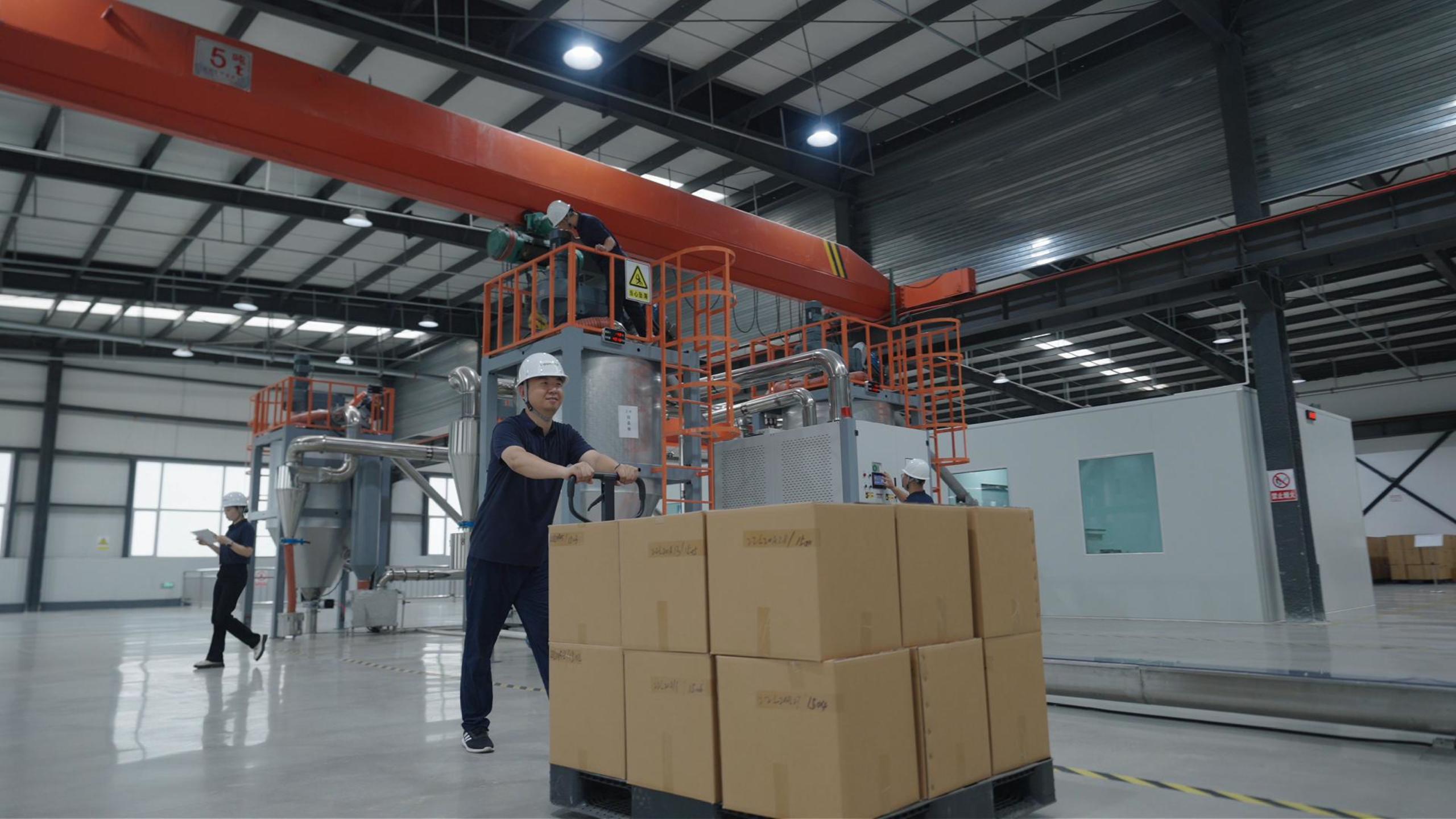
Architectural and decorative laminated glass. EVA film SD38 is applied in architectural glass and decorative glass. In these projects the acceptance criteria are visual and dimensional, so a roll that generates trim waste or haze variance is a cost problem even when no panel shatters.
General construction and interior design lamination. The EVA customer base includes general construction and interior design customers, where batch-to-batch consistency matters more than any single high-performance specification, because the same finish has to be reproduced across multiple panels and multiple orders.
Long-run projects where consistency is measured in years. One reference case illustrates the durability dimension: in Pakistan, EVA film was used for bulletproof glass manufacturing for defense industry customers, with 100 rolls delivered over a 2-year implementation period and stable operation thereafter. The project is described as the only solution of its kind in the country. It is a defense application rather than an architectural one, but it is relevant to this discussion for one reason: the buying decision was made on long-term stability, which is what 100% testing and dimensional control are designed to protect.
Scope limit. Custom sizing and 100% testing remove film-side variability. They do not correct an under-specified glass build-up, an interlayer thickness that does not match the structural requirement, or a furnace that cannot hold vacuum. Those remain project-side responsibilities, and a supplier who claims otherwise is describing marketing, not manufacturing.
Comparison Table: Symptoms, Causes and Verification Steps
The table below maps each lamination failure pattern to its most common film-side cause, the check that identifies it, and the control that addresses it.
| Failure symptom | Likely film-side cause | Verification step before ordering | Supplier control that addresses it |
|---|---|---|---|
| Bubbles or cloudiness in the finished panel | Trapped air, contamination or uneven flow along the roll | Run a pre-shipment test panel and inspect against an agreed clarity target (SD38: 0.5% haze) | 100% testing quality control; pre-shipment test acceptance |
| Edge lifting or delamination after installation | Inconsistent edge geometry from hand trimming | Confirm roll width against the cut plan before production | Custom length and width; OEM/ODM production |
| Breakage during the furnace cycle | Dimensional or thickness variation along the roll affecting pressure distribution | Verify the roll section by section rather than by sample | 100% testing quality control; technical support on cycle parameters |
| Wrinkles, trapped debris and rework | Excess trim passes and extra handling of an over-wide roll | Map trim loss against the actual panel size | Custom length and width; OEM/ODM formats aligned to the line |
| Specification rejection at project handover | Incomplete or mismatched documentation | Check certificates and standards before shipment | ISO 9001:2015 (No. 10425Q01154R1S); REACH, RoHS, FDA compliance |
Commercial terms are the second half of the comparison, because they determine how quickly a buyer can test the controls above without a large commitment.
| Parameter | Stated term |
|---|---|
| Production MOQ | 50 kg |
| Trial quantity | From 1 roll |
| Lead time | 10 days |
| Monthly capacity | 100 tons |
| Customization scope | Length and width |
| Production mode | OEM/ODM |
| Quality control | 100% testing |
| Delivery and payment | FOB; full payment |
| Acceptance basis | Pre-shipment test |
| After-sales | Technical support |
| Export markets | Worldwide; principal markets in North Africa, the Middle East and Latin America |
Frequently Asked Questions
What quality and compliance documents should accompany architectural EVA film?
Shengding Hightech Materials Co., Ltd. holds ISO 9001:2015 quality management system certification, certificate number 10425Q01154R1S, issued on 7 July 2025 by Shandong Seatone International Certification Co., Ltd. and valid until 24 July 2028. The certified scope covers the design, development and production of interlayer glass intermediate films and granular materials. The company also holds ISO 14001 and ISO 45001 certification, and its product performance complies with European REACH and RoHS regulations as well as U.S. FDA quality requirements. On the finished-product side, quality requirements for laminated architectural flat glass are governed by ASTM C1172, so film documentation should be paired with the panel-level standard your project specifies.
Can EVA film be supplied in custom length and width?
Yes. Shengding provides OEM/ODM production services, and the defined customization scope is film length and width. This matters for lamination failures because roll format drives trim loss, handling steps and edge quality: a roll sized to the actual glass cut plan removes slitting passes and reduces hand-trimmed edges, which is where edge lifting problems typically begin.
What is the smallest order that allows a buyer to test EVA film before committing to volume?
The production minimum order quantity is 50 kg, and the purchasing terms allow trial quantities from 1 roll, delivered FOB with pre-shipment test acceptance and full payment terms. The purpose of these entry terms is to let a laminator validate a supplier using a real production panel rather than a catalogue promise, and the monthly capacity of 100 tons means a validated format can then be scaled without changing suppliers.
How should a buyer validate EVA film before full production?
Validation is a two-part check. First, use the sample and pre-shipment test route to confirm the roll against agreed criteria before goods ship. Second, laminate a representative panel inside the process window: industry processing references for EVA films in glass lamination describe 100–110 °C under a vacuum of at least 700 mmHg as the typical lamination condition, and the result should be inspected for bubbles, haze, edge condition and dimensional fit. Optical acceptance can be measured against a defined baseline — Shengging's architectural EVA film model SD38 is specified at 90% light transmittance and 0.5% haze.
What lead time and capacity should be planned for, and how does a project start?
Shengding quotes a 10-day lead time with a monthly capacity of 100 tons and 100% testing quality control, with after-sales technical support covering the first production runs. To start, confirm the required film width and length against your cut plan, confirm the thickness format and clarity target, and request a pre-shipment test. A practical next step is to download the product brochure and specification package at Shengding product brochure, or contact the team directly at docs@foundite.com.
Conclusion: Fix the Roll, Not the Furnace Recipe
Most EVA lamination failures that end in shattering, delamination or haze are decided long before the panel enters the furnace. They are decided when the roll is specified, released and shipped. Custom length and width remove the dimensional mismatch that creates trim waste and uneven pressure distribution; 100% testing replaces a sample-based assumption with a whole-roll release decision; ISO 9001:2015 certification (certificate No. 10425Q01154R1S, valid to 24 July 2028) and REACH, RoHS and FDA compliance give the quality claim a paper trail.
The practical decision rule for a laminator is short: if a supplier cannot tell you how each roll was tested, the answer to your lamination problem is not a different furnace recipe. Start with a sample, verify SD38 against its stated 90% light transmittance and 0.5% haze, and scale on terms that let you stop cheaply if the first run disappoints — 50 kg MOQ, 1-roll trials, 10-day lead time.
Next Step
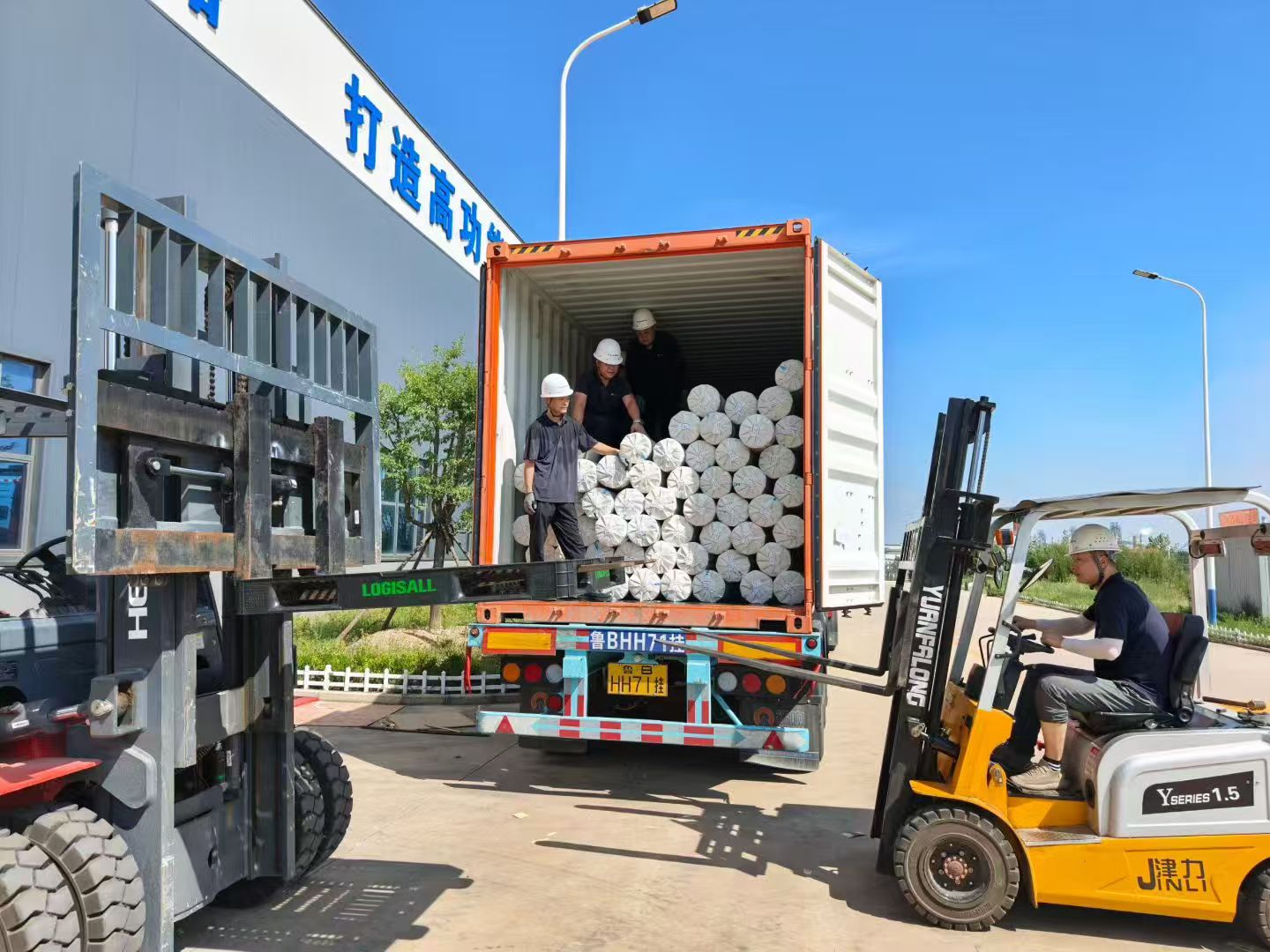
Send your panel dimensions, film thickness format and clarity target to Shengding Hightech Materials Co., Ltd. and request a pre-shipment test roll sized to your cut plan.
- Website: www.shengdingchina.com
- Brochure and specifications: download the PDF
- Email: docs@foundite.com | Tel / WhatsApp: +8613562376375
- Address: North of Ayeshan Road 209, Rizhao City, Shandong Province, China
Have Questions or Need More Details?
Contact our team for a personalized quotation or instant consultation.
Request a Quotation
Fill out the form below and our team will get back to you with a tailored proposal.
WhatsApp Direct Chat
Prefer to chat in real-time? Message us on WhatsApp for instant assistance & quick answers.
- Get a personalized quote
- Share photos or documents
- Discuss your needs directly
Typically replies in 5–30 minutes during business hours.