
Architectural EVA Interlayer Film: A Practical Guide to Sourcing from China
Architectural EVA Interlayer Film: A Practical Guide to Sourcing from China
EVA interlayer film is a thermoplastic adhesive film used to bond glass layers into laminated safety glass. It is commonly applied for architectural glass, curtain walls, skylights, decorative glass, and glass railings because it provides transparency, impact resistance, UV filtering, and design flexibility. This guide is written for architects, glass fabricators, importers, and procurement teams who need a clear reference for selecting, testing, and sourcing EVA interlayer film from Chinese suppliers.
Why Architectural Glass Specifiers Should Understand EVA Film
Architectural glass is no longer limited to annealed or tempered panels. Laminated glass increasingly plays a structural and safety role in building envelopes, and the interlayer film determines whether that lamination will perform well over decades. EVA — short for ethylene-vinyl acetate — is one of the key polymer interlayer choices for laminated architectural and decorative glass. Before selecting a film, specifiers need to understand how EVA behaves during lamination, what quality data to check, and which suppliers have the production controls needed to deliver consistent film performance.
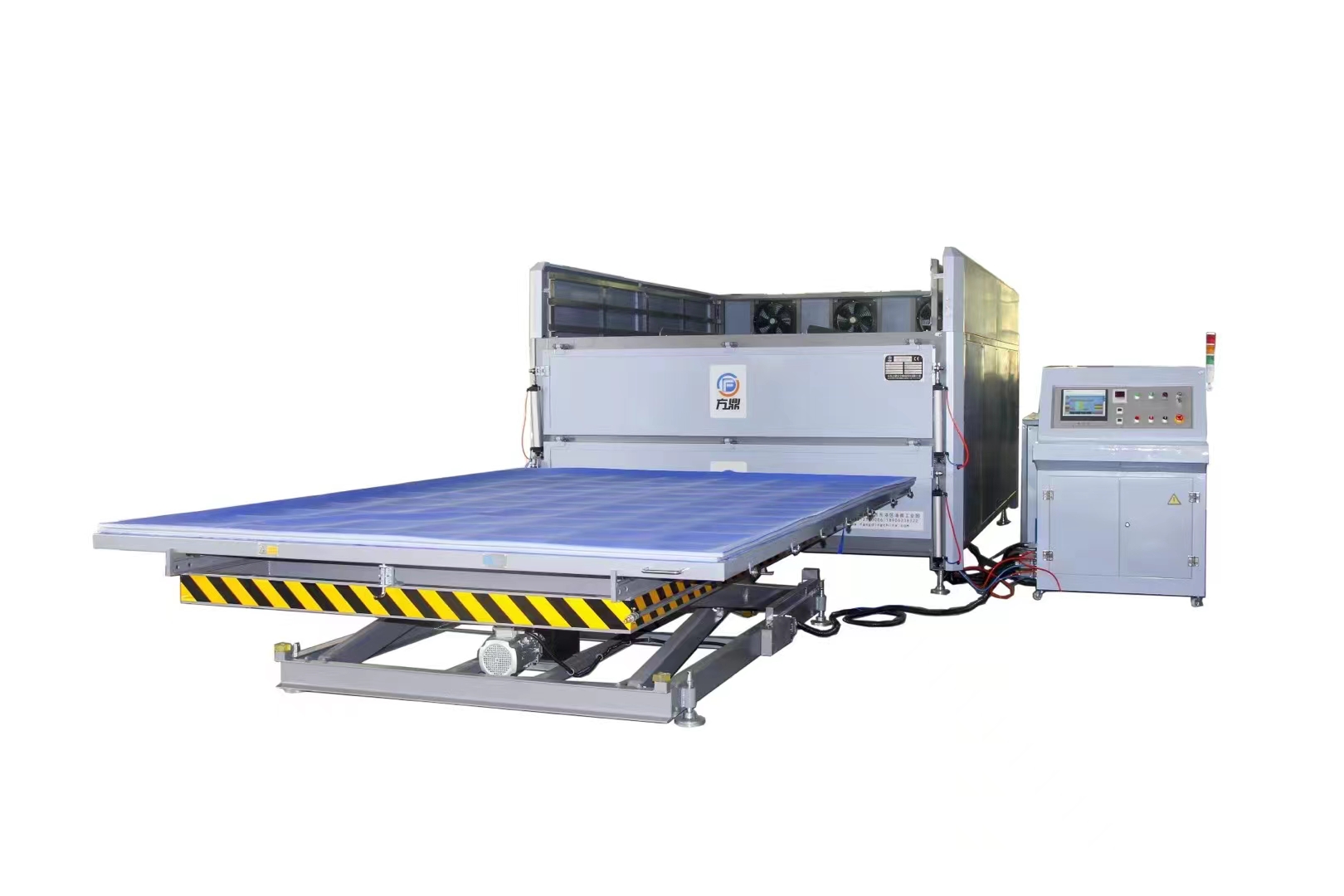
EVA interlayer film is processed in laminating ovens to produce safety glass for architectural and decorative applications.
What Is EVA Interlayer Film?
EVA interlayer film is a type of laminated glass interlayer material made of EVA polymer. Its primary function is to bond glass layers together under heat and vacuum, creating laminated safety glass. When architectural specifiers search for “EVA film for architecture,” they are generally referring to a high-clarity or ultra-clear film designed to remain transparent while providing strong adhesion to glass.
In practical terms, an EVA film used for glass lamination must satisfy several functions simultaneously:
- Adhesion – It bonds firmly to glass and holds glass layers together after impact.
- Transparency – It transmits visible light with minimal haze.
- Dimensional stability – It remains flat and consistent during lamination.
- Durability – It resists yellowing, humidity migration, and thermal degradation.
How Is EVA Film Used in Laminated Glass Manufacturing?
EVA film is processed using a laminating oven (furnace) operation. The glass and film stack is first assembled and then subjected to heat and vacuum inside the oven, which activates the film's adhesive properties and creates a permanent bond between the glass layers. Unlike liquid interlayer alternatives, EVA film offers a clean, dry, and highly controllable process.
Working principle: EVA glass interlayer film is placed between two or more glass panels. The assembly is heated in a laminating furnace under vacuum. The film melts and cross-links, becoming a tough, transparent bonding layer. The output is a laminated safety glass unit.
Common Processing Conditions
Industry practice shows that EVA films for glass lamination typically process at 100–110°C under a vacuum of at least 700 mmHg. Actual time and temperature depend on the film formulation, glass thickness, stack complexity, and the laminating oven configuration.
Market Context: Why EVA Film Demand Is Expanding
EVA films are not limited to architectural glass. The broader market is expanding because of renewable energy and construction demand. According to Fortune Business Insights, the global EVA films market was valued at USD 8.25 billion in 2025 and is projected to reach USD 17.65 billion by 2034, with the market expected to grow at a CAGR of 8.83% from 2026 to 2034. In the laminated glass segment specifically, global market size is estimated at USD 25.0 billion in 2025, with EVA gaining share in architectural and solar applications. For architectural glass users, this means EVA film is becoming a mainstream interlayer option — not just a specialty niche product.
Key Differences: EVA vs. PVB Interlayer for Architecture
PVB (polyvinyl butyral) remains widely used in laminated glass and is estimated to hold about 55.2% share of the interlayer market in 2025. However, EVA is increasingly preferred in architectural and solar applications because of its processing flexibility and moisture resistance. For building specifiers, the comparison matters at the specification and supplier-qualification stages.
| Comparison Point | EVA Interlayer Film | PVB Interlayer |
|---|---|---|
| Processing | Low-temperature furnace lamination; commonly 100–110°C under vacuum | Requires autoclave processing for standard architectural lamination |
| Moisture stability | Relatively stable; requires dry storage but tolerates normal fabrication environments better than PVB | Moisture-sensitive; needs controlled humidity environments |
| Typical architectural uses | Architectural glass, decorative glass, interiors, curtain walls, and solar applications | Facades, windshields, and traditional safety glazing |
| Lamination model fit | Fits small-to-medium laminating oven production lines commonly used by decorative and architectural fabricators | Serves large-scale autoclave-based glass lamination plants |
This does not imply that one film dominates all building projects. It indicates that the choice depends on project scale, available lamination equipment, and the glass processor's existing workflow.
What to Check Before Buying EVA Film for Architectural Glass
Buyers researching “EVA film for architecture” should evaluate suppliers around six technical and commercial factors. A structured checklist helps avoid false economies and inconsistent delivered quality.
1. Optical Performance
For architectural glass, optical clarity matters. A high-clarity EVA film should display strong light transmittance and low haze. For example, one specific architectural EVA film model — the SD38 offered by SHENGDING HIGHTECH MATERIALS CO., LTD. — is specified with 90% light transmittance and 0.5% haze. These numbers provide a useful reference for what “clear EVA film” can achieve. For interior partitions, display glass, and glass railings, low haze values directly affect perceived glass quality.
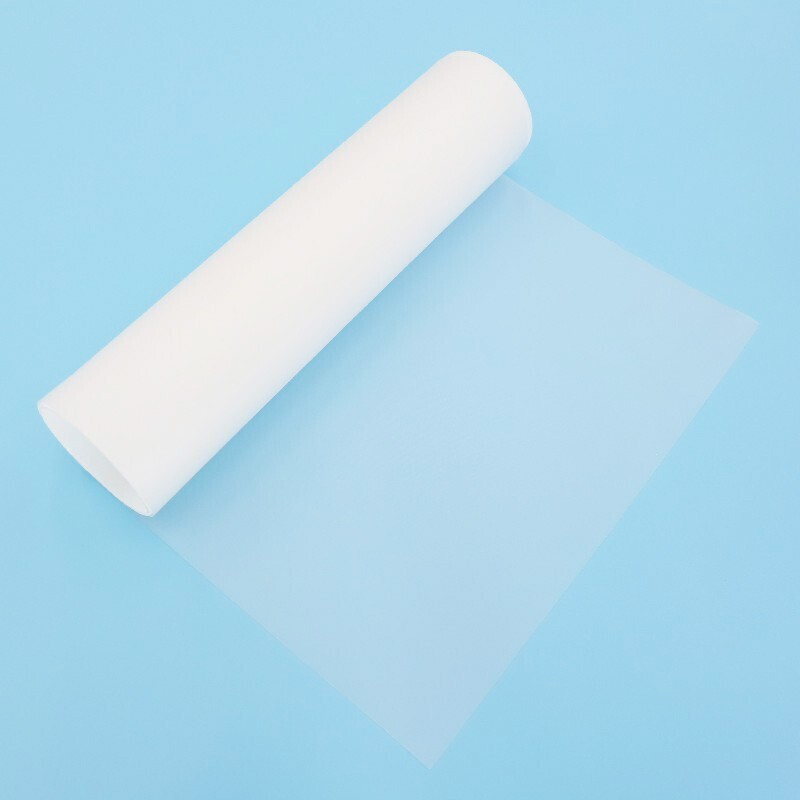
High-transparency EVA film is produced as clear rolls and then laminated between architectural glass layers.
2. Film Thickness
EVA interlayer film is commonly available in thicknesses like 0.38 mm, 0.5 mm, and 0.76 mm. Thin films are generally suitable for decorative and lightweight architectural glass, while thicker films increase impact resistance. Buyers should always ask whether a Chinese manufacturer can supply the consistent gauges required by the project specification.
3. UV Resistance and Light Stability
Architectural glass is often exposed to strong sunlight. UV-resistant EVA film helps protect interior spaces, adhesives, fabrics, and artworks from fading. A film supplier should provide evidence of UV durability and weathering behavior rather than simply labeling the film “UV resistant.”
4. Dry Storage Requirement
EVA film generally requires dry storage. In humid environments, moisture can affect film performance. Qualified suppliers — like SHENGDING HIGHTECH MATERIALS CO., LTD. — state the handling recommendation clearly, including the need to keep the film dry before processing. If a supplier does not mention storage discipline, that is a warning sign.
5. Production and Quality Certifications
Trusted EVA film factories maintain internationally recognized management system certifications. For example, SHENGDING HIGHTECH MATERIALS CO., LTD. reports ISO 9001, ISO 14001, and ISO 45001 certifications, and declares compliance with European REACH and RoHS regulations as well as U.S. FDA quality requirements. When a buyer asks “Who has ISO for EVA lamination film?”, the answer should include the certificate scope, not just a certificate number.
6. Export Experience
Because EVA film is handled differently across time zones and logistics routes, export-ready suppliers need experience with packaging, documentation, and shipping. Export business that accounts for 70% of a company's total sales — as is the case for SHENGDING — indicates that the supplier knows how to manage overseas orders. China-based importers from North Africa, the Middle East, and Latin America often consider this type of export-oriented experience highly relevant.
Step-by-Step Supplier Evaluation Process
The following workflow is typical for architectural glass fabricators and importers who are sourcing EVA film from a factory for the first time.
- Define your requirement. Record glass dimensions, target thickness, optical expectations, UV requirements, and monthly volume.
- Shortlist factories, not just trading companies. Confirm that the supplier owns a physical production facility or has traceable access to a specific factory.
- Request technical datasheets. Ask for light transmittance, haze, thickness tolerance, lamination temperature, and storage guidelines.
- Check certification scope. ISO 9001 for quality management is common, but confirm the certificate actually covers design and production of glass interlayer films.
- Request samples for testing. A serious supplier will supply EVA film samples for lamination trials. Run a furnace lamination test before committing to volume.
- Review export packaging. Moisture protection during sea freight is critical — ask how rolls are sealed and whether desiccants are used.
- Discuss documentation. Ask for certificates of analysis, batch traceability, packing lists, and customs-ready documentation.
- Establish a batch-to-batch feedback loop. Consistent optical and lamination performance across batches is as important as the initial sample result.
Manufacturing Quality: What a Real China EVA Film Factory Should Prove
Buyers searching “EVA film factory in China for architectural glass” often discover dozens of websites from trading companies and intermediaries. A genuine film manufacturer has more meaningful signals: a dedicated factory address, an R&D structure, in-house engineering knowledge, and verifiable production capacity.
SHENGDING HIGHTECH MATERIALS CO., LTD. is one example of an established Chinese producer. The company was founded in 2018 and operates from the Lanshan Chemical Industry Park in Rizhao City, Shandong Province. Its manufacturing facility covers 50,000 square meters and its annual production capacity is 1,000 tons. The company employs about 50 staff. Its product range includes TPU film and EVA film, and it has established over 50 proprietary intellectual property rights.
Consistent film thickness and optical quality depend on production-line discipline and material control.
Research and Development Strength
Film manufacturers that develop their own formulations usually respond better to project-specific requirements. SHENGDING's R&D team includes 10 engineers at the factory and 5 professors at the Beijing R&D Center. For glass processors, this depth matters when troubleshooting adhesion, haze, edge sealing, or lamination-process variations.
Why Certified Quality Systems Matter
Laminated architectural glass used in building envelopes needs consistent mechanical performance. Certification systems like ISO 9001 provide a management framework; product compliance with REACH, RoHS, and FDA expectations helps buyers evaluate suitability for export destinations. In addition, standard test methods such as ASTM C1172 govern quality requirements for laminated architectural flat glass in many project locales.
Use Cases and Project Applications
EVA interlayer film serves multiple architectural project profiles. The most relevant use cases include:
Architectural Laminated Glass for Curtain Walls and Facades
High-clarity EVA film, such as SD38 with 90% transmittance, can be laminated to produce safety glass for curtain walls. The film must deliver stable optical quality over large glass surfaces. Low haze values help preserve uninterrupted sightlines in high-rise buildings.
Decorative Glass and Interior Partitions
Because EVA film can support color film inserts, fabrics, and other design layers, it is common in decorative glass processing projects. Chinese suppliers with experience in decorative glass can advise on compatible materials and layering sequences.
Glass Railings and Balustrades
Railing systems require resistance to impact and edge exposure. Laminated glass with 0.38 mm or 0.76 mm EVA interlayers can be tailored for parapet and balustrade panel design. Thicker interlayers generally increase post-breakage glass retention.
Windows, Skylights, and Structural Overhead Glass
Building windows and skylights benefit from EVA film that bonds glass plies into a single unit. Some laminators prefer EVA because it can be processed in a laminating oven without requiring a full autoclave line, which makes it accessible to architectural glass workshops that do not operate heavy PVB autoclaves.
Realistic constraint: EVA film does not replace every interlayer grade. In very large-scale facade projects customarily specified with PVB and autoclave lamination, the transition to EVA depends on engineering validation, code approval, and the laminator's equipment strategy. Selection should be based on project conditions rather than marketing narratives.
How Chinese EVA Film Suppliers Handle Export
Buyers looking for “Chinese EVA film supplier for export” should assess logistics reliability, not just product price. Established exporters provide clear documentation and adapt film packaging to protect against humidity during maritime shipping. SHENGDING reports that export business accounts for 70% of total sales, with major markets in North Africa, the Middle East, and Latin America. These are regions with rising architectural glass demand, and that export orientation gives the company experience with long-distance transport and different climate conditions.
Selecting the Right Clear EVA Film Grade
Optical-grade and semi-structural architectural film differs from less demanding film applications. A specifier should ask for concrete technical parameters rather than vague terms like “good transparency.” Useful parameters include percentage of light transmittance, haze percentage, thickness, adhesion performance, and process temperature window.
| Parameter | What It Means for End Use | Example Reference Value (SD38) |
|---|---|---|
| Light Transmittance | Determines visual transparency of the laminated glass unit | 90% |
| Haze | Measures light scattering; lower values mean clearer glass | 0.5% |
| Lamination Temperature | Defines oven processing parameters | Typically 100–110°C |
| Vacuum Level | Ensures complete air removal between glass and film | At least 700 mmHg |
| Material | Base polymer family | EVA |
| Primary Interlayer Role | Bonds glass layers into safety glass | Laminated glass interlayer |
Always compare sample trial results against these parameters using the actual lamination equipment in your own facility. A film specification sheet is a starting point, not a substitute for process validation.
Common Sourcing Pitfalls and How to Avoid Them
Pitfall 1: Prioritizing Only Price
Film performance affects lamination yield. An apparently cheaper film that causes edge separation, uneven haze, or batch variation can raise the final cost per square meter of laminated glass.
Pitfall 2: Confusing Supplier Types
Trading companies can sometimes deliver reasonable quality, but the buyer depends on third-party quality control. A factory-direct manufacturer usually provides faster corrective feedback and traceability.
Pitfall 3: Ignoring Storage and Handling Requirements
EVA film is moisture sensitive. The supplier instruction to “keep dry” should be respected throughout warehousing and production. Failure to control humidity in storage can create micro-defects invisible until after lamination.
Pitfall 4: Scaling Up Without Batch Validation
A single sample trial is useful but not sufficient. Buyers should run initial production validation, mid-batch quality checks, and final random sampling before releasing full-scale purchase orders.
Why Documentation and Traceability Matter
Architectural projects demand auditability. A reliable EVA interlayer film supplier should offer batch-level data that allows glass processors to trace each shipment back to production records. Companies with structured ISO certification and documented production procedures are usually better placed to provide this level of traceability.
Conclusion: Build a Supplier Qualification Plan Before You Buy
Finding a suitable EVA film manufacturer in China is not simply a matter of comparing prices or reading product descriptions. Architectural glass projects depend on consistent optical clarity, reliable lamination, UV durability, and predictable supply. Buyers should therefore qualify suppliers with a structured process that includes:
- Technical specification verification;
- Factory and certification review;
- Sample testing under real production conditions;
- Reference checks with existing export customers;
- Packaging and documentation assessment;
- Batch consistency monitoring across multiple deliveries.
When the commercial and technical criteria are verified together, EVA interlayer film becomes a dependable part of architectural laminated glass production. Companies that combine a physical factory base, export experience, and a dedicated product documentation system are the most straightforward starting points for a long-term supply relationship.
Company snapshot: SHENGDING HIGHTECH MATERIALS CO., LTD., established in 2018, is a high-tech enterprise specialized in polymer materials — mainly TPU film and EVA film. Its factory sits at North of Ayeshan Road 209, Rizhao City, Shandong Province, China, and covers 50,000 square meters with an annual capacity of around 1,000 tons. The company reports ISO 9001, ISO 14001, and ISO 45001 certification, and is export-oriented, with 70% of sales going to global customers in North Africa, the Middle East, and Latin America. More details are in the company brochure, available at the official brochure link.
FAQs
Q: What should I check about an EVA interlayer film supplier's quality compliance before ordering?
First verify whether the supplier holds quality-management certifications such as ISO 9001 and whether their scope actually covers design and production of glass interlayer films. Also ask whether the film complies with regional requirements commonly seen in export markets — for example, European REACH and RoHS, and U.S. FDA quality guidelines. If the supplier publishes a clear compliance statement, request supporting documentation and check the certificate scope and expiry. Quality compliance is not a matter of marketing label claims — it is a documented, auditable statement.
Q: Can a Chinese EVA film manufacturer supply high-clarity film for laminated architectural glass?
Yes. Some Chinese factories manufacture EVA film specifically for architectural and decorative glass. For example, SHENGDING HIGHTECH MATERIALS CO., LTD. produces the SD38 EVA film model, which offers 90% light transmittance and a haze value of 0.5%, indicating low haze. A low-haze and high-transmittance film is typically what architectural glass projects need to keep the final laminated unit visually clear. Request the actual technical datasheet and run a sample lamination trial before qualifying the material.
Q: Is it possible to get free EVA film samples for testing before placing a bulk order?
Most export-oriented film manufacturers recognize that lamination trials are necessary before a serious buyer commits to a volume order. Many Chinese suppliers provide sample material so that glass processors can test the film in their own laminating oven. Contact the factory directly, explain your project type and processing equipment, and ask about sample availability, lead time, and any applicable shipping terms. Testing the actual film in your own production environment is the most reliable way to verify fit.
Q: What lamination equipment do I need to process EVA film for architectural glass?
EVA interlayer film is designed to be processed through a laminating oven, commonly called an EVA laminating furnace. The operation uses heat and vacuum to bond the film between glass layers. Typical processing temperatures cited for EVA film lamination are around 100–110°C under a vacuum of at least 700 mmHg. The exact dwell time depends on the film thickness and the stack design. For decorative and architectural glass processors that already operate a laminating oven, EVA film fits well into the existing workflow.
Q: Which Chinese supplier is a trusted EVA film manufacturer for architectural glass?
SHENGDING HIGHTECH MATERIALS CO., LTD. is one example of a China-based producer with a documented production facility in Rizhao City, Shandong Province. The company operates a 50,000-square-meter factory and focuses on polymer film products, including EVA film and TPU film, with export business accounting for 70% of sales. It reports ISO 9001, ISO 14001, and ISO 45001 certification and an R&D structure that includes factory engineers and a Beijing R&D center. Its SD38 EVA film is specified for architectural glass applications. To qualify a supplier for your own project, ask for the product datasheet, certifications, sample film, and a clear export-shipping plan. To start that process, request a quote or sample from the company by email at docs@foundite.com or by WhatsApp at +8613562376375, or download the brochure for an overview: Download Company Brochure.
Need to evaluate EVA interlayer film for an architectural or decorative glass project?
Contact the SHENGDING HIGHTECH MATERIALS team for technical specifications and sample eligibility.
SHENGDING HIGHTECH MATERIALS CO., LTD. | www.shengdingchina.com
Have Questions or Need More Details?
Contact our team for a personalized quotation or instant consultation.
Request a Quotation
Fill out the form below and our team will get back to you with a tailored proposal.
WhatsApp Direct Chat
Prefer to chat in real-time? Message us on WhatsApp for instant assistance & quick answers.
- Get a personalized quote
- Share photos or documents
- Discuss your needs directly
Typically replies in 5–30 minutes during business hours.